Naveen

 Naveen
📅 Last Updated: 12 Dec, 2024
Naveen
📅 Last Updated: 12 Dec, 2024
How to Optimized Hyperparameters in Machine Learning
Firstly, let’s discuss what is the difference between Hyperparameters and parameters. Hyperparameters: These are the parameters which can be arbitrarily...
Read More →
Naveen
📅 Last Updated: 12 Dec, 2024
How to Avoid Overfitting in Machine Learning
Overfitting is a common problem in machine learning where a model performs well on training data, but fails to generalize...
Read More →
Naveen
📅 Last Updated: 12 Dec, 2024
5 Tricks to Improve Your Machine Learning Models
Improving Machine Learning model can be challenging sometime. Even after trying all the strategies which you have learned, you would...
Read More →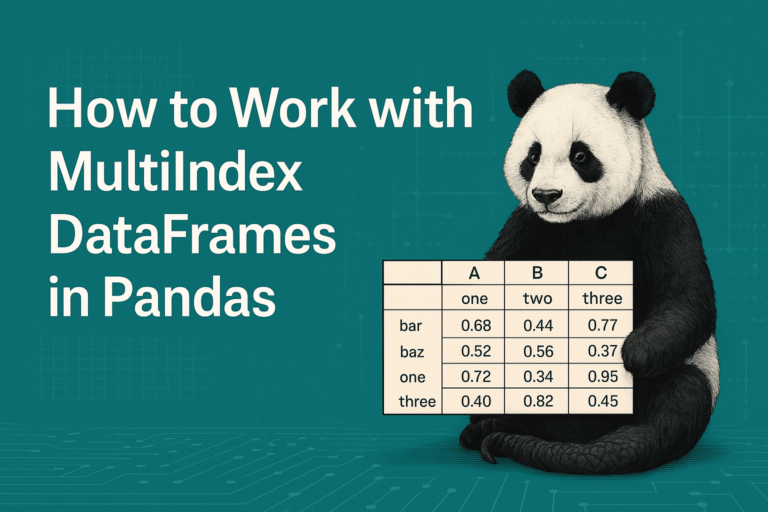 Naveen
📅 Last Updated: 16 Nov, 2025
Naveen
📅 Last Updated: 16 Nov, 2025
How to Work with Multiindex DataFrames in Pandas
In this blog we are going to talk about how to handle MultiIndex DataFrames in Pandas. As we know that...
Read More → Naveen
📅 Last Updated: 16 Nov, 2025
Naveen
📅 Last Updated: 16 Nov, 2025
5 Pandas Functions for Data Wrangling
Data wrangling is the process of cleaning and transforming raw data into a structured format which can be analyzed. Pandas...
Read More → Naveen
📅 Last Updated: 16 Nov, 2025
Naveen
📅 Last Updated: 16 Nov, 2025
How to Transform Data in Python
Pandas is a powerful and popular library for data processing and analysis in Python. It offers a wide range of...
Read More →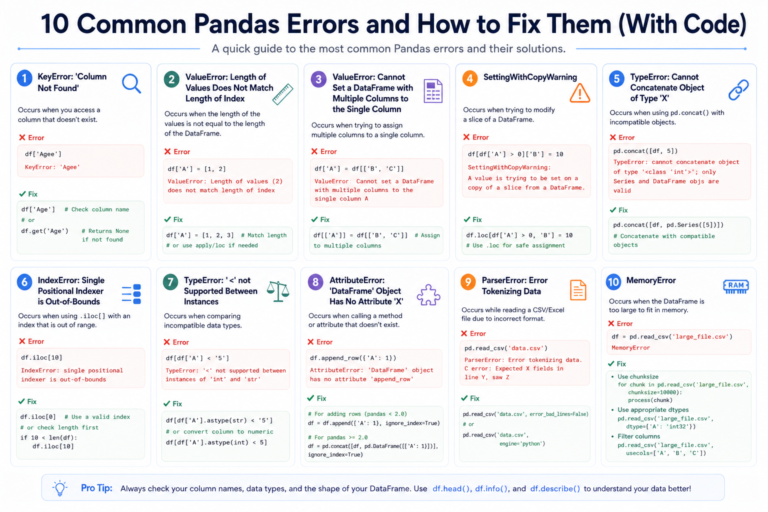 Naveen
📅 Last Updated: 08 Aug, 2026
Naveen
📅 Last Updated: 08 Aug, 2026
10 Common Pandas Errors and How to Fix Them (With Code)
When you are working with data in Python you have probably seen common pandas errors times. Maybe you have even...
Read More →
Naveen
📅 Last Updated: 12 Dec, 2024
Advanced String Manipulation with Pandas
Pandas is a popular Python library for data analysis that provides powerful techniques for data manipulation, cleaning, and exploration. One...
Read More →
Naveen
📅 Last Updated: 12 Dec, 2024
How to Create a Pivot Table in Pandas?
Pandas is a popular Python library used for data manipulation and analysis. One of the most powerful features of Pandas...
Read More →
Naveen
📅 Last Updated: 12 Dec, 2024
Advanced Grouping Techniques with Pandas
Pandas is a powerful data manipulation library that provides a variety of functionalities to handle and analyze large datasets. One...
Read More →
Naveen
📅 Last Updated: 12 Dec, 2024
Combining Multiple Pandas DataFrames: Best Practices
In this article we will be looking at combining Multiple Pandas DataFrames. In the world of Python and data analysis,...
Read More →
Naveen
📅 Last Updated: 12 Dec, 2024
How to Use Pandas for Time Series Data
Pandas is a powerful Python library that provides rich data analysis capabilities. One of its key strengths is its ability...
Read More →