
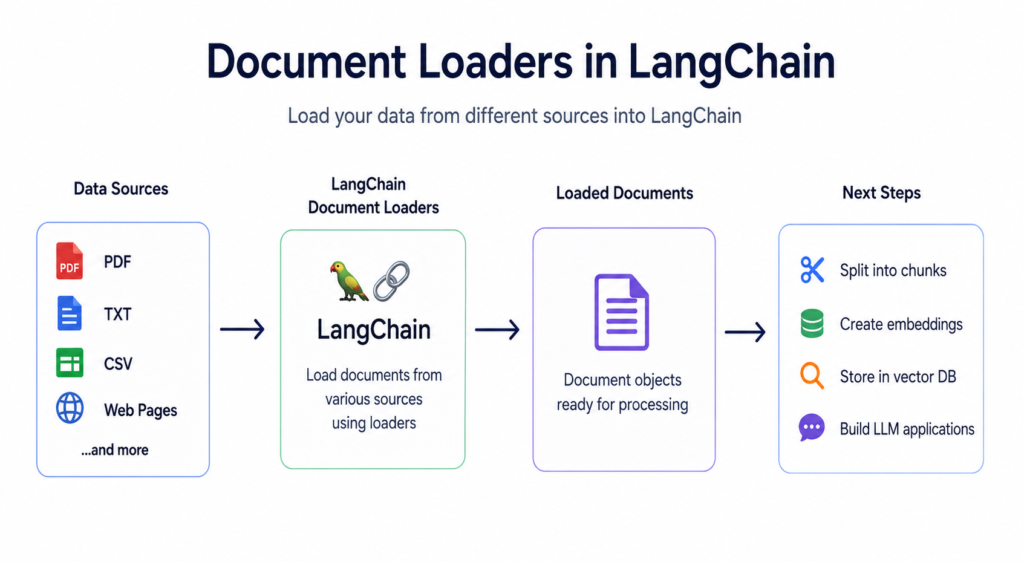
Every RAG pipeline, every document Q&A system, every LangChain application that uses data begins in the same spot. Document loaders in LangChain. Before you can split text turn it into numbers save it in a vector database or bring it back when someone asks a question you have to get your data into LangChain’s Document format. That is what document loaders are, for.
This article is, about the important document loaders. It has working code. The guide explains what the Document object looks like. Every loader gives you this kind of Document object. You will see how loaders work with a RAG pipeline. The guide also talks about things that other tutorials do not cover, like loading things when you need them handling mistakes and changing metadata to suit your needs. The guide covers document loaders. It shows you how document loaders work.
Table of Contents
- What Are Document Loaders and Why Do They Matter?
- The Document Object — What Every Loader Returns
- load() vs lazy_load() — Which to Use When
- TextLoader
- CSVLoader
- JSONLoader
- DirectoryLoader
- PyPDFLoader and PDF Variants
- WebBaseLoader
- UnstructuredFileLoader
- ArxivLoader
- Docx2txtLoader
- YouTubeAudioLoader
- NotionDirectoryLoader
- Where Document Loaders Fit in a RAG Pipeline
- Choosing the Right Loader — Quick Reference
- FAQs
What Are Document Loaders and Why Do They Matter?
A document loader in LangChain is a standardised connector that fetches data from a specific source — a file, a URL, a database, an API — and converts it into a consistent Document object that the rest of the LangChain ecosystem can work with.
The reason they matter is simple: data comes in an enormous variety of formats. PDFs, CSVs, Word files, web pages, YouTube transcripts, Notion databases, Slack messages, S3 buckets — every source has its own structure, encoding, and extraction challenges. Document loaders abstract all of that away. Your text splitter, embedder, and vector store don’t need to know or care where the data came from — they just receive a list of Document objects.
                    ┌──────────────┐
                    │ Your Data    │
                    │ PDF, CSV,    │
                    │ Web, JSON... │
                    └──────┬───────┘
                           │
                    ┌──────▼───────┐
                    │  Document    │
                    │  Loader      │  ← This article
                    └──────┬───────┘
                           │
                    ┌──────▼───────┐
                    │  Document    │
                    │  Objects     │
                    └──────┬───────┘
                           │
               ┌───────────▼────────────┐
               │   Text Splitter        │
               └───────────┬────────────┘
                           │
               ┌───────────▼────────────┐
               │   Embeddings           │
               └───────────┬────────────┘
                           │
               ┌───────────▼────────────┐
               │   Vector Store         │
               └───────────┬────────────┘
                           │
               ┌───────────▼────────────┐
               │   Retriever / RAG      │
               └────────────────────────┘
LangChain has over 100 document loaders — covering everything from local files to cloud storage to social media APIs. You can find the full list in the LangChain documentation. This guide covers the ones you’ll actually use regularly.
The Document Object — What Every Loader Returns
Before touching a single loader, understand the output format. Every document loader in LangChain returns a list of Document objects. Each Document has exactly two fields:
from langchain_core.documents import Document

# This is what every loader produces — always
doc = Document(
    page_content="This is the actual text content of the document.",
    metadata={
        "source": "/path/to/file.txt",
        "page": 0,
        # ... any other key-value pairs
    }
)

print(f"Type          : {type(doc)}")
print(f"page_content  : {doc.page_content[:50]}...")
print(f"metadata      : {doc.metadata}")
print(f"All attributes: {doc.__dict__.keys()}")
Output:
Type          : <class 'langchain_core.documents.base.Document'>
page_content  : This is the actual text content of the document....
metadata      : {'source': '/path/to/file.txt', 'page': 0}
All attributes: dict_keys(['page_content', 'metadata'])
page_content holds the raw text. metadata holds everything else — source path, page number, row index, creation date, author, whatever the loader can extract. Understanding this structure is important because downstream components (text splitters, retrievers, chains) access these fields by name.
load() vs lazy_load() — Which to Use When
Every loader supports two loading modes. Knowing which to use saves you from out-of-memory errors on large datasets.
# load() — reads everything into memory at once
# Use for: small to medium files, simple scripts
docs = loader.load()
print(f"Loaded {len(docs)} documents into memory")

# lazy_load() — returns a generator, processes one document at a time
# Use for: large directories, many files, memory-constrained environments
for doc in loader.lazy_load():
    process(doc)  # each doc is loaded and processed before the next is fetched
from langchain_community.document_loaders import DirectoryLoader
import os
# Practical example: large directory — use lazy_load to avoid OOM
loader = DirectoryLoader('./documents/', glob="**/*.txt")
# BAD for large dirs — loads everything at once
# all_docs = loader.load()
# GOOD — processes one at a time
total = 0
for doc in loader.lazy_load():
total += 1
# Process each doc without keeping all in memory
print(f"Processed {total} documents")Rule of thumb: load() for anything under a few hundred documents or a few hundred MB. lazy_load() for anything bigger.
TextLoader
The simplest loader — reads a plain text file and returns it as a single Document.
from langchain_community.document_loaders import TextLoader

# Basic usage
loader = TextLoader('/content/sample.txt')
docs = loader.load()

print(f"Number of documents : {len(docs)}")
print(f"Content preview     : {docs[0].page_content[:200]}")
print(f"Metadata            : {docs[0].metadata}")
Output:
Number of documents : 1
Content preview     : India, country that occupies the greater part of South Asia.
                      India is made up of 28 states and eight union territories...
Metadata            : {'source': '/content/sample.txt'}
TextLoader loads the entire file as one Document. If your file is large, combine it with a text splitter downstream to chunk it into smaller pieces.
Handling Encoding Issues
A common real-world problem — files with non-UTF-8 encoding throw errors with the default settings:
from langchain_community.document_loaders import TextLoader

# Files with special characters or non-standard encoding
try:
    loader = TextLoader('legacy_document.txt')
    docs = loader.load()
except UnicodeDecodeError:
    # Specify encoding explicitly
    loader = TextLoader('legacy_document.txt', encoding='latin-1')
    docs = loader.load()
    print("Loaded with latin-1 encoding")

# Or use autodetect
loader = TextLoader('unknown_encoding.txt', autodetect_encoding=True)
docs = loader.load()
CSVLoader
CSVLoader turns each row of a CSV into a separate Document — exactly the right behaviour for tabular data where each row represents a distinct record.
import pandas as pd
from langchain_community.document_loaders.csv_loader import CSVLoader

# First, create a sample CSV
data = {
    'product_id': ['P001', 'P002', 'P003', 'P004'],
    'name': ['Laptop Pro', 'Wireless Mouse', 'Mechanical Keyboard', 'USB Hub'],
    'price': [89999, 1999, 5499, 2999],
    'category': ['Electronics', 'Peripherals', 'Peripherals', 'Accessories'],
    'review': [
        'Excellent performance, great battery life',
        'Smooth scrolling, ergonomic design',
        'Satisfying tactile feedback, RGB lighting',
        'Multiple ports, plug and play'
    ]
}
df = pd.DataFrame(data)
df.to_csv('products.csv', index=False)

# Basic load
loader = CSVLoader(file_path='products.csv')
docs = loader.load()

print(f"Documents loaded: {len(docs)}\n")
for doc in docs[:2]:
    print(f"Content  : {doc.page_content}")
    print(f"Metadata : {doc.metadata}\n")
Output:
Documents loaded: 4

Content  : product_id: P001
name: Laptop Pro
price: 89999
category: Electronics
review: Excellent performance, great battery life
Metadata : {'source': 'products.csv', 'row': 0}

Content  : product_id: P002
name: Wireless Mouse
price: 1999
category: Peripherals
review: Smooth scrolling, ergonomic design
Metadata : {'source': 'products.csv', 'row': 1}
Using source_column for Better Traceability
# Use product_id as the source — makes attribution clearer in RAG
loader = CSVLoader(
    file_path='products.csv',
    source_column='product_id'
)
docs = loader.load()

for doc in docs[:2]:
    print(f"Source: {doc.metadata['source']}  ← product ID, not file path")
    print(f"Row   : {doc.metadata['row']}\n")
Output:
Source: P001  ← product ID, not file path
Row   : 0

Source: P002  ← product ID, not file path
Row   : 1
This matters when you’re building a Q&A system over product data — knowing the answer came from product P001, not just “row 0 of products.csv”, makes citations meaningful to users.
Loading Only Specific Columns
# If you only want certain columns in the document content
loader = CSVLoader(
    file_path='products.csv',
    csv_args={
        'fieldnames': ['name', 'review']  # only load name and review
    }
)
JSONLoader
JSONLoader handles structured JSON data and uses JQ expressions to specify exactly which fields to extract as document content.
import json

# Create sample JSON data
data = [
    {
        "id": 1,
        "title": "Introduction to RAG",
        "author": "Naveen",
        "content": "RAG combines retrieval with generation to ground LLM responses in real documents.",
        "tags": ["RAG", "LangChain", "AI"]
    },
    {
        "id": 2,
        "title": "Vector Databases Explained",
        "author": "Naveen",
        "content": "Vector databases store embeddings and enable semantic similarity search at scale.",
        "tags": ["VectorDB", "embeddings", "AI"]
    },
    {
        "id": 3,
        "title": "Prompt Engineering Basics",
        "author": "Naveen",
        "content": "Good prompts are clear, specific, and include relevant context for the model.",
        "tags": ["prompts", "LLM", "AI"]
    }
]

with open('articles.json', 'w') as f:
    json.dump(data, f)
# pip install jq
from langchain_community.document_loaders import JSONLoader
# Extract just the content field from each article
loader = JSONLoader(
file_path='articles.json',
jq_schema='.[] | .content',
text_content=True
)
docs = loader.load()
print(f"Documents loaded: {len(docs)}\n")
for doc in docs:
print(f"Content : {doc.page_content[:70]}...")
print(f"Metadata : {doc.metadata}\n")Output:
Documents loaded: 3

Content  : RAG combines retrieval with generation to ground LLM responses...
Metadata : {'source': 'articles.json', 'seq_num': 1}

Content  : Vector databases store embeddings and enable semantic similarity...
Metadata : {'source': 'articles.json', 'seq_num': 2}

Content  : Good prompts are clear, specific, and include relevant context...
Metadata : {'source': 'articles.json', 'seq_num': 3}
Extracting Multiple Fields and Adding Metadata
# Extract content + add title as metadata using a metadata_func
def metadata_func(record, metadata):
    metadata['title'] = record.get('title', '')
    metadata['author'] = record.get('author', '')
    metadata['id'] = record.get('id', '')
    return metadata

loader = JSONLoader(
    file_path='articles.json',
    jq_schema='.[]',
    content_key='content',
    metadata_func=metadata_func
)
docs = loader.load()

print("With custom metadata:\n")
for doc in docs:
    print(f"Content  : {doc.page_content[:50]}...")
    print(f"Metadata : {doc.metadata}\n")
Output:
With custom metadata:

Content  : RAG combines retrieval with generation to gro...
Metadata : {'source': 'articles.json', 'seq_num': 1, 'title': 'Introduction to RAG', 'author': 'Naveen', 'id': 1}

Content  : Vector databases store embeddings and enable ...
Metadata : {'source': 'articles.json', 'seq_num': 2, 'title': 'Vector Databases Explained', 'author': 'Naveen', 'id': 2}
Rich metadata like this makes retrieval much more useful — when a user asks a question and the system retrieves a document, it can cite the article title and author, not just a JSON file path.
DirectoryLoader
The DirectoryLoader is really useful because it can load all the files in a directory and it does this in a way. This means it looks at all the files in a folder. Then it also looks at all the files in any folders inside that folder. This is great when you have a lot of files like hundreds of them that are spread out across folders inside each other. The DirectoryLoader is essential when your knowledge base is made up of a number of files, like this.
from langchain_community.document_loaders import DirectoryLoader, TextLoader

# Load all markdown files recursively
loader = DirectoryLoader(
    path='./docs/',
    glob='**/*.md',
    loader_cls=TextLoader,
    show_progress=True,
    use_multithreading=True
)
docs = loader.load()

print(f"Total documents loaded: {len(docs)}")

# Check what we got
sources = set(doc.metadata['source'] for doc in docs)
print(f"\nFiles loaded:")
for src in sorted(sources):
    print(f"  {src}")
Loading Different File Types from the Same Directory
from langchain_community.document_loaders import DirectoryLoader, TextLoader
from langchain_community.document_loaders import PyPDFLoader
from langchain_community.document_loaders.csv_loader import CSVLoader

# Mix of file types — load each type with its appropriate loader
all_docs = []

# Load markdown files
md_loader = DirectoryLoader('./docs/', glob='**/*.md', loader_cls=TextLoader)
all_docs.extend(md_loader.load())

# Load PDF files
pdf_loader = DirectoryLoader('./docs/', glob='**/*.pdf', loader_cls=PyPDFLoader)
all_docs.extend(pdf_loader.load())

print(f"Total documents from mixed sources: {len(all_docs)}")

# Breakdown by file type
from collections import Counter
extensions = Counter(
    doc.metadata['source'].split('.')[-1]
    for doc in all_docs
)
print(f"By file type: {dict(extensions)}")
PyPDFLoader and PDF Variants
PDFs are the most common document format in enterprise RAG applications — contracts, research papers, reports, manuals. LangChain has multiple PDF loaders, each with different trade-offs.
PyPDFLoader — Best Starting Point
from langchain_community.document_loaders import PyPDFLoader

loader = PyPDFLoader("research_paper.pdf")
pages = loader.load()

print(f"Total pages : {len(pages)}")
print(f"\nPage 1 preview:")
print(pages[0].page_content[:400])
print(f"\nPage 1 metadata: {pages[0].metadata}")
Output:
Total pages : 22

Page 1 preview:
MachineLearning-Lecture01
Instructor (Andrew Ng): Okay. Good morning. Welcome to CS229, the machine
learning class. So what I wanna do today is just spend a little time going
over the logistics of the class, and then we'll start to talk a bit about
machine learning.

Page 1 metadata: {'source': 'research_paper.pdf', 'page': 0}
Each page becomes its own Document. The page field in metadata lets you cite specific page numbers in retrieval results critical for academic and legal use cases.
Loading PDFs from URLs
from langchain_community.document_loaders import OnlinePDFLoader

# Load a PDF directly from a URL — no download needed
loader = OnlinePDFLoader("https://arxiv.org/pdf/2302.03803.pdf")
docs = loader.load()
print(f"Loaded {len(docs)} page(s) from URL")
print(f"Preview: {docs[0].page_content[:200]}")
Comparing PDF Loaders
# Different loaders handle the same PDF differently
# Use the one that extracts your specific PDF's content best

loaders = {
    "PyPDFLoader"        : "from langchain_community.document_loaders import PyPDFLoader",
    "PyMuPDFLoader"      : "from langchain_community.document_loaders import PyMuPDFLoader",  # faster, more metadata
    "PDFMinerLoader"     : "from langchain_community.document_loaders import PDFMinerLoader",  # better layout preservation
    "UnstructuredPDFLoader": "from langchain_community.document_loaders import UnstructuredPDFLoader",  # handles scanned PDFs
}

# PyMuPDFLoader — fastest, richest metadata
from langchain_community.document_loaders import PyMuPDFLoader
loader = PyMuPDFLoader("document.pdf")
docs = loader.load()
# Metadata includes: page, source, total_pages, author, creator, producer, subject, title
print(f"PyMuPDF metadata keys: {list(docs[0].metadata.keys())}")| Loader | Speed | Metadata | Scanned PDFs | Best For |
|---|---|---|---|---|
PyPDFLoader | Fast | Basic | Don’t do This | Most use cases |
PyMuPDFLoader | Fastest | Rich | Don’t do this | When you need metadata |
PDFMinerLoader | Medium | Medium | Don’t do this | Layout-sensitive PDFs |
UnstructuredPDFLoader | Slow | Rich | Do this | Scanned or complex PDFs |
WebBaseLoader
WebBaseLoader fetches and parses web pages using BeautifulSoup. Ideal for loading documentation sites, news articles, or any web content.
from langchain_community.document_loaders import WebBaseLoader

# Single URL
loader = WebBaseLoader("https://github.com/basecamp/handbook/blob/master/37signals-is-you.md")
docs = loader.load()

print(f"Content length : {len(docs[0].page_content)} characters")
print(f"Preview        :\n{docs[0].page_content[:300]}")
Loading Multiple URLs at Once
from langchain_community.document_loaders import WebBaseLoader

# Batch loading — much faster than loading one URL at a time
urls = [
    "https://www.nomidl.com/natural-language-processing/what-is-natural-language-processing/",
    "https://www.nomidl.com/deep-learning/what-are-convolutional-neural-networks/",
    "https://www.nomidl.com/machine-learning/what-is-unsupervised-learning/",
]

loader = WebBaseLoader(urls)
docs = loader.load()

print(f"Loaded {len(docs)} pages\n")
for doc in docs:
    print(f"  Source: {doc.metadata.get('source', 'unknown')}")
    print(f"  Length: {len(doc.page_content)} chars\n")
Filtering HTML Content
import bs4
from langchain_community.document_loaders import WebBaseLoader

# Only extract content from specific HTML elements
# Useful for news sites, blogs, documentation
loader = WebBaseLoader(
    web_paths=["https://www.nomidl.com/generative-ai/document-loaders-in-langchain/"],
    bs_kwargs=dict(
        parse_only=bs4.SoupStrainer(
            class_=("article-content", "post-content", "entry-content")
        )
    )
)
docs = loader.load()
print(f"Filtered content: {docs[0].page_content[:300]}")
UnstructuredFileLoader
When you don’t know the file type in advance, or when you’re dealing with formats that don’t have dedicated loaders, UnstructuredFileLoader is your fallback. It uses the unstructured library to auto-detect and parse the file.
# pip install unstructured
from langchain_community.document_loaders import UnstructuredFileLoader

# Works on: txt, pdf, docx, pptx, xlsx, html, and more
loader = UnstructuredFileLoader('mystery_document.txt')
docs = loader.load()

print(f"Auto-detected and loaded as {len(docs)} document(s)")
print(f"Content: {docs[0].page_content[:200]}")
Element Mode — More Granular Structure
from langchain_community.document_loaders import UnstructuredFileLoader

# mode="elements" preserves document structure — headings, paragraphs, lists
loader = UnstructuredFileLoader(
    'document.txt',
    mode="elements"
)
docs = loader.load()

print("Document elements:\n")
for doc in docs[:3]:
    print(f"  Category: {doc.metadata.get('category', 'unknown')}")
    print(f"  Content : {doc.page_content[:80]}")
    print()
Output:
Document elements:

  Category: Title
  Content : The Rise of Generative Models

  Category: NarrativeText
  Content : Generative AI refers to deep-learning models that can take raw data...

  Category: NarrativeText
  Content : Among the first class of AI models to achieve this cross-over feat...
Element mode is particularly useful when building RAG systems over structured documents like reports or articles — you can filter for headings to build a document outline, or treat each paragraph as a separate retrievable chunk.
ArxivLoader
For anyone building research tools, academic Q&A systems, or staying current with AI papers — ArxivLoader directly fetches papers from arXiv by their paper ID.
from langchain_community.document_loaders import ArxivLoader

# Load the "Attention is All You Need" paper (the transformer paper)
# arXiv ID: 1706.03762
docs = ArxivLoader(
    query="1706.03762",
    load_max_docs=1
).load()

print(f"Papers loaded : {len(docs)}")
print(f"\nMetadata:")
for key, value in docs[0].metadata.items():
    print(f"  {key}: {value}")

print(f"\nAbstract preview:")
print(docs[0].page_content[:500])
Output:
Papers loaded : 1

Metadata:
  Published: 2017-06-12
  Title: Attention Is All You Need
  Authors: Ashish Vaswani, Noam Shazeer, Niki Parmar, ...
  Summary: The dominant sequence transduction models are based on complex
           recurrent or convolutional neural networks...

Abstract preview:
The dominant sequence transduction models are based on complex recurrent
or convolutional neural networks that include an encoder and a decoder...
# Search by topic instead of paper ID
docs = ArxivLoader(
query="RAG retrieval augmented generation",
load_max_docs=3
).load()
print(f"Found {len(docs)} relevant papers:\n")
for doc in docs:
print(f" Title : {doc.metadata['Title']}")
print(f" Authors : {doc.metadata['Authors'][:50]}...")
print(f" Published: {doc.metadata['Published']}\n")Docx2txtLoader
For Microsoft Word documents — one of the most common formats in enterprise environments.
from langchain_community.document_loaders import Docx2txtLoader

loader = Docx2txtLoader("report.docx")
docs = loader.load()

print(f"Documents loaded : {len(docs)}")
print(f"Content preview  : {docs[0].page_content[:300]}")
print(f"Metadata         : {docs[0].metadata}")
Output:
Documents loaded : 1
Content preview  : Q3 Financial Report
                   Executive Summary
                   Revenue grew 23% YoY driven by strong enterprise adoption...
Metadata         : {'source': 'report.docx'}
Note that Docx2txtLoader loads the entire document as one Document, ignoring images and complex formatting. For documents where headings and section structure matter, UnstructuredFileLoader in element mode gives you richer structural information.
YouTubeAudioLoader
For building tools that work with video content — load and transcribe YouTube videos using OpenAI’s Whisper.
# pip install yt_dlp pydub
from langchain_community.document_loaders.generic import GenericLoader
from langchain_community.document_loaders.parsers import OpenAIWhisperParser
from langchain_community.document_loaders.blob_loaders.youtube_audio import YoutubeAudioLoader

url = "https://www.youtube.com/watch?v=jGwO_UgTS7I"
save_dir = "docs/youtube/"

loader = GenericLoader(
    YoutubeAudioLoader([url], save_dir),
    OpenAIWhisperParser()
)
docs = loader.load()

print(f"Transcript length : {len(docs[0].page_content)} characters")
print(f"Preview           : {docs[0].page_content[:300]}")
This downloads the audio, runs it through Whisper for transcription, and returns the transcript as a Document. Useful for building search tools over lectures, podcasts, or YouTube tutorials. Requires an OpenAI API key for the Whisper transcription step.
NotionDirectoryLoader
For teams that store knowledge in Notion, NotionDirectoryLoader loads exported Notion databases or pages.
from langchain_community.document_loaders import NotionDirectoryLoader

# Point to the exported Notion directory
loader = NotionDirectoryLoader("docs/Notion_DB")
docs = loader.load()

print(f"Notion pages loaded : {len(docs)}")
for doc in docs[:2]:
    print(f"\nContent  : {doc.page_content[:200]}")
    print(f"Metadata : {doc.metadata}")
To use this, first export your Notion workspace: Settings → Export → Markdown & CSV. The loader handles the markdown files that come out of that export.
Where Document Loaders Fit in a RAG Pipeline
Here’s a complete, minimal RAG pipeline showing exactly where loaders plug in:
# pip install langchain langchain-community langchain-openai faiss-cpu pypdf
from langchain_community.document_loaders import PyPDFLoader, WebBaseLoader
from langchain.text_splitter import RecursiveCharacterTextSplitter
from langchain_openai import OpenAIEmbeddings, ChatOpenAI
from langchain_community.vectorstores import FAISS
from langchain.chains import RetrievalQA

# Step 1: Load documents (this article's focus)
pdf_loader = PyPDFLoader("knowledge_base.pdf")
web_loader = WebBaseLoader(["https://www.nomidl.com/generative-ai/"])

pdf_docs = pdf_loader.load()
web_docs = web_loader.load()
all_docs = pdf_docs + web_docs

print(f"Step 1 — Loaded: {len(all_docs)} documents")

# Step 2: Split into chunks
splitter = RecursiveCharacterTextSplitter(
    chunk_size=1000,
    chunk_overlap=200
)
chunks = splitter.split_documents(all_docs)
print(f"Step 2 — Split into: {len(chunks)} chunks")

# Step 3: Embed and store
embeddings = OpenAIEmbeddings()
vectorstore = FAISS.from_documents(chunks, embeddings)
print(f"Step 3 — Stored in vector database")

# Step 4: Create retrieval chain
retriever = vectorstore.as_retriever(search_kwargs={"k": 3})
llm = ChatOpenAI(model="gpt-4o", temperature=0)

qa_chain = RetrievalQA.from_chain_type(
    llm=llm,
    chain_type="stuff",
    retriever=retriever,
    return_source_documents=True
)

# Step 5: Query
result = qa_chain.invoke({"query": "What are document loaders in LangChain?"})

print(f"\nAnswer: {result['result']}")
print(f"\nSource documents:")
for doc in result['source_documents']:
    print(f"  - {doc.metadata.get('source')} (page {doc.metadata.get('page', 'N/A')})")
Document loaders are step one, but they influence everything downstream — the metadata they attach determines what citations your RAG system can provide, and the content quality they extract determines the quality of retrieval.
Choosing the Right Loader — Quick Reference
| Source | Loader | Notes |
|---|---|---|
Plain text .txt | TextLoader | Simplest, entire file as one doc |
| CSV | CSVLoader | One doc per row, use source_column |
| JSON | JSONLoader | Requires jq expression for field selection |
| PDF (local) | PyPDFLoader | One doc per page, fast |
| PDF (URL) | OnlinePDFLoader | Direct URL loading |
| PDF (scanned) | UnstructuredPDFLoader | OCR support via unstructured |
Word .docx | Docx2txtLoader | Text only, no images |
| Web page | WebBaseLoader | BeautifulSoup parsing |
| Directory | DirectoryLoader | Recursive, specify loader per file type |
| arXiv paper | ArxivLoader | By paper ID or search query |
| YouTube | YoutubeAudioLoader + WhisperParser | Requires OpenAI key |
| Notion | NotionDirectoryLoader | Needs exported Notion directory |
| Unknown format | UnstructuredFileLoader | Auto-detects file type |
| Any URL | UnstructuredURLLoader | Good fallback for web content |
Conclusion
Document loaders in LangChain are the entry point for every data pipeline you’ll build. The loader you choose determines what metadata is available for citations, how much content is preserved, and how much preprocessing is needed downstream.
For most projects: start with PyPDFLoader for PDFs, WebBaseLoader for web content, CSVLoader for tabular data, and TextLoader for plain text. Use UnstructuredFileLoader when you need auto-detection or richer structural parsing. Use lazy_load() any time you’re dealing with more than a few hundred documents to keep memory usage under control.
The metadata that loaders attach — source path, page number, row index, author — is worth paying attention to from day one. It’s what lets your RAG system tell users where an answer came from, which is often as important as the answer itself.
FAQs
1. What are document loaders in LangChain?
Document loaders are standardised connectors in LangChain that fetch data from various sources — files, URLs, databases, APIs — and convert it into Document objects with page_content and metadata fields. They abstract away format-specific parsing so the rest of your LangChain pipeline (text splitters, embeddings, vector stores) works the same way regardless of where the data came from.
2. What is a Document object in LangChain?
A Document in LangChain has two fields: page_content (the text content as a string) and metadata (a dictionary of key-value pairs like source path, page number, author, etc.). Every document loader returns a list of these objects, regardless of the original data format.
3. Which LangChain loader should I use for PDFs?
Start with PyPDFLoader — it’s fast, splits by page, and works for most PDFs. Use PyMuPDFLoader when you need richer metadata (author, title, creation date). Use UnstructuredPDFLoader for scanned PDFs that need OCR. Use OnlinePDFLoader to load PDFs directly from a URL without downloading first.
4. What is the difference between load() and lazy_load() in LangChain?
load() reads all documents into memory at once and returns a list — simple but memory-intensive for large datasets. lazy_load() returns a generator that loads one document at a time, making it suitable for large directories or files where loading everything at once would cause memory issues. Use load() for small datasets, lazy_load() for large ones.
5. How do document loaders fit into a RAG pipeline?
Document loaders are always the first step — they convert raw data into Document objects. Those documents are then split into chunks by a text splitter, the chunks are embedded into vectors, and those vectors are stored in a vector database for retrieval. Without the loader step, none of the downstream pipeline has any data to work with.
6. Can I load multiple file types from one directory?
Yes. Use DirectoryLoader with glob patterns to target specific file types, and specify the appropriate loader_cls for each type. For a mixed directory, run multiple DirectoryLoader instances with different glob patterns and combine the resulting document lists.
Related reading on Nomidl: Building a Production-Ready RAG Application with Milvus and LangChain — see document loaders used in a complete production RAG system. See What is Model Context Protocol (MCP)? — the emerging alternative to document loaders for connecting AI systems to external data sources.
External reference: LangChain Document Loaders documentation — the complete list of 100+ available loaders with integration guides.
Popular Posts
- Build and Evaluate a RAG Pipeline with RAGAS, LangChain, FAISS, and Groq (Step-by-Step Guide)
- Loop Engineering Explained: From Prompt Engineering to Self-Prompting AI Agents
- Build Your First MCP Server with FastMCP: A Complete Python Tutorial
- MCP vs Function Calling: Key Differences Explained (2026)
- What Is Model Context Protocol (MCP) – A Complete Guide for AI Developers