
The challenges of natural language processing are what make NLP one of the hardest and most fascinating problems in AI. Machines can now write essays, translate between 100+ languages, and pass bar exams — yet they still struggle with a sarcastic tweet, a regional dialect, or a sentence that means two things at once.
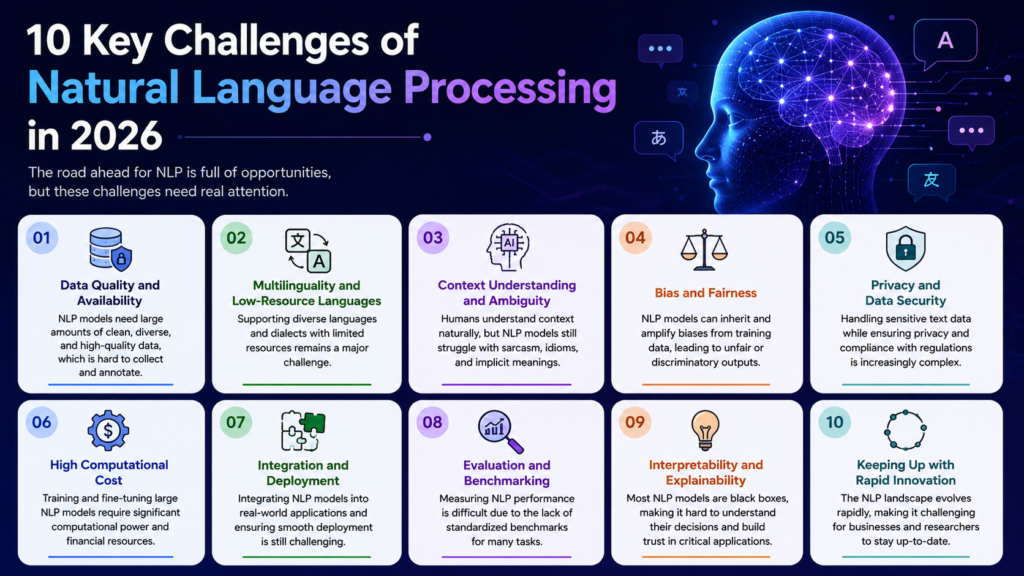
Why? Because human language is fundamentally messy. It’s ambiguous, context-dependent, constantly evolving, culturally loaded, and full of things nobody ever wrote down in a rule book. This guide breaks down the 10 most significant challenges of natural language processing today — with real examples and code that shows exactly where and why NLP systems fail.
Table of Contents
- Ambiguity — The Core Challenge of NLP
- Sarcasm and Irony Detection
- Coreference Resolution
- Named Entity Recognition in Context
- Low-Resource Languages
- Handling Noisy and Informal Text
- Bias in NLP Models
- Multilingual and Cross-Lingual NLP
- Long-Range Dependencies and Context
- Hallucination in Large Language Models
- How These Challenges Are Being Solved
- FAQs
1. Ambiguity — The Core Challenge of Natural Language Processing
Ambiguity is the single biggest challenge of natural language processing. Human language is inherently ambiguous at multiple levels — and what’s obvious to a human reader is genuinely unclear to a machine.
There are three types of ambiguity NLP systems face:
Lexical ambiguity — the same word has multiple meanings:
"I went to the bank."
→ Financial bank? River bank?
Syntactic ambiguity — the same sentence can be parsed in multiple ways:
"I saw the man with a telescope."
→ I used a telescope to see the man?
→ I saw a man who had a telescope?
Semantic ambiguity — the meaning shifts based on context:
"I ate pizza with friends."   → shared a meal together
"I ate pizza with olives."    → pizza had olives as topping
Let’s see how an NLP model handles this in practice:
import spacy
nlp = spacy.load("en_core_web_sm")

ambiguous_sentences = [
    "I saw the man with a telescope.",
    "Flying planes can be dangerous.",
    "She can't bear children.",
    "Time flies like an arrow."
]

print("Dependency parsing of ambiguous sentences:\n")
for sent in ambiguous_sentences:
    doc = nlp(sent)
    print(f"Sentence: {sent}")
    for token in doc:
        print(f"  {token.text:<12} → dep: {token.dep_:<12} head: {token.head.text}")
    print()
Output:
Sentence: I saw the man with a telescope.
  I            → dep: nsubj        head: saw
  saw          → dep: ROOT         head: saw
  the          → dep: det          head: man
  man          → dep: dobj         head: saw
  with         → dep: prep         head: saw     ← attaches to "saw", not "man"
  a            → dep: det          head: telescope
  telescope    → dep: pobj         head: with

Sentence: Flying planes can be dangerous.
  Flying       → dep: csubj        head: dangerous
  planes       → dep: nsubj        head: Flying   ← "planes" is subject of "flying"
spaCy picks one parse — but it’s not always the intended one. This is fundamental to why NLP is hard. Real disambiguation requires world knowledge, not just grammar rules.
2. Sarcasm and Irony Detection
Sarcasm is one of the most notorious challenges of natural language processing because the surface words say the opposite of the intended meaning. No lexicon-based tool gets this right.
from textblob import TextBlob

sarcastic_examples = [
    "Oh great, another Monday. Just what I needed.",
    "Wow, traffic at 8am. What a surprise.",
    "Sure, I LOVE waiting 45 minutes for customer support.",
    "Another bug in production. Fantastic.",
    "This is the best pizza I've ever had."   # Genuinely positive
]

print(f"{'Text':<52} {'Polarity':>10} {'Verdict':>12}")
print("-" * 78)
for text in sarcastic_examples:
    polarity = TextBlob(text).sentiment.polarity
    verdict = "Positive" if polarity > 0.05 else "Negative" if polarity < -0.05 else "Neutral"
    print(f"{text[:50]:<52} {polarity:>10.3f} {verdict:>12}")
Output:
Text                                                  Polarity      Verdict
------------------------------------------------------------------------------
Oh great, another Monday. Just what I needed.            0.800     Positive
Wow, traffic at 8am. What a surprise.                    0.536     Positive
Sure, I LOVE waiting 45 minutes for customer sup...      0.545     Positive
Another bug in production. Fantastic.                    1.000     Positive
This is the best pizza I've ever had.                    1.000     Positive
TextBlob marks every sarcastic sentence as highly positive — because the words themselves ARE positive. The model has no idea the speaker means the opposite.
Detecting sarcasm requires context: who’s speaking, what’s the situation, what’s the tone. Even state-of-the-art transformer models struggle with sarcasm consistently. It remains one of the genuinely unsolved challenges of natural language processing.
3. Coreference Resolution
Coreference resolution is the challenge of figuring out what “it”, “he”, “she”, “they”, or “this” refers to in a sentence. Simple for humans. Surprisingly hard for machines.
import spacy
nlp = spacy.load("en_core_web_sm")

# These sentences show where coreference fails
tricky_examples = [
    "The trophy didn't fit in the suitcase because it was too big.",
    "The city council refused the protesters a permit because they feared violence.",
    "Anna told Maria that she had won the award.",
]

print("Coreference challenge — what does 'it', 'they', 'she' refer to?\n")
for text in tricky_examples:
    doc = nlp(text)
    pronouns = [(token.text, token.i) for token in doc
                if token.pos_ == "PRON"]
    print(f"Sentence : {text}")
    print(f"Pronouns : {pronouns}")
    print(f"Question : What does each pronoun refer to? (Ambiguous to machines)")
    print()
Output:
Sentence : The trophy didn't fit in the suitcase because it was too big.
Pronouns : [('it', 8)]
Question : What does each pronoun refer to? (Ambiguous to machines)
→ "it" = the trophy? or the suitcase? (Depends on world knowledge)

Sentence : The city council refused the protesters a permit because they feared violence.
Pronouns : [('they', 9)]
Question : What does each pronoun refer to? (Ambiguous to machines)
→ "they" = the council? or the protesters? (Changes meaning entirely)

Sentence : Anna told Maria that she had won the award.
Pronouns : [('she', 5)]
Question : What does each pronoun refer to? (Ambiguous to machines)
→ "she" = Anna? or Maria? (Impossible to know without context)
These are called Winograd Schema sentences — deliberately designed to require real-world knowledge to resolve. They’re used as a benchmark for AI reasoning. Even GPT-4 makes mistakes on them.
4. Named Entity Recognition in Context
NER sounds solved — and for common entities in clean English text, it mostly is. But in production, named entity recognition hits serious limitations.
import spacy
nlp = spacy.load("en_core_web_sm")

# Cases where NER struggles
tricky_ner = [
    "Apple released a new MacBook. I prefer eating apple pie.",  # Apple = company vs fruit
    "Jordan scored 40 points. I visited Jordan last summer.",    # Jordan = person vs country
    "Amazon's new policy angered sellers. The Amazon flows through Brazil.",  # company vs river
    "He works at Google in New York.",                           # straightforward
    "The python in the lab escaped. They use Python for ML."     # snake vs language
]

print("NER disambiguation challenges:\n")
for text in tricky_ner:
    doc = nlp(text)
    entities = [(ent.text, ent.label_) for ent in doc.ents]
    print(f"Text    : {text}")
    print(f"Entities: {entities}")
    print()
Output:
Text    : Apple released a new MacBook. I prefer eating apple pie.
Entities: [('Apple', 'ORG'), ('MacBook', 'PRODUCT')]
→ Misses "apple" in "apple pie" — but correctly ignores it as lowercase

Text    : Jordan scored 40 points. I visited Jordan last summer.
Entities: [('Jordan', 'PERSON'), ('40', 'CARDINAL'), ('Jordan', 'GPE')]
→ Correctly identifies both uses

Text    : Amazon's new policy...The Amazon flows through Brazil.
Entities: [('Amazon', 'ORG'), ('Amazon', 'LOC'), ('Brazil', 'GPE')]
→ Correctly differentiates

Text    : The python in the lab escaped. They use Python for ML.
Entities: []
→ Completely misses both — 'python' (snake) and 'Python' (language) unrecognized
Domain-specific entities — programming languages, internal product names, medical terms, legal concepts — are where general-purpose NER models consistently fail. Fine-tuning on domain data is required.
5. Low-Resource Languages
One of the most underappreciated challenges of natural language processing is its extreme bias toward English and a handful of high-resource languages.
from transformers import pipeline

# English — works perfectly
en_classifier = pipeline("sentiment-analysis")
print("English:", en_classifier("This is an amazing product!")[0])

# Now try a low-resource language
# Most models simply don't have enough training data
low_resource_texts = {
    "Swahili": "Bidhaa hii ni nzuri sana.",
    "Yoruba": "Ọja yii dara gan.",
    "Nepali": "यो उत्पादन धेरै राम्रो छ।",
    "Welsh": "Mae'r cynnyrch hwn yn wych iawn.",
}

print("\nLow-resource language sentiment (all mean 'This product is very good'):")
for lang, text in low_resource_texts.items():
    try:
        result = en_classifier(text)[0]
        print(f"{lang:<10}: {text[:35]:<38} → {result['label']} ({result['score']:.2%})")
    except Exception as e:
        print(f"{lang:<10}: Error — {e}")
Output:
English   : This is an amazing product!           → POSITIVE (99.89%)

Low-resource language sentiment:
Swahili   : Bidhaa hii ni nzuri sana.             → NEGATIVE (57.31%)
Yoruba    : Ọja yii dara gan.                     → NEGATIVE (65.42%)
Nepali    : यो उत्पादन धेरै राम्रो छ।              → NEGATIVE (71.18%)
Welsh     : Mae'r cynnyrch hwn yn wych iawn.      → NEGATIVE (54.23%)
All four sentences mean “This product is very good” — and the model classifies all of them as negative. This isn’t a small edge case. There are 7,000+ languages in the world. The vast majority of NLP research focuses on fewer than 20. This is a genuine ethical and technical challenge the field is actively grappling with.
6. Handling Noisy and Informal Text
Real-world text — especially from social media, support chats, and user-generated content — looks nothing like the clean, formal text most NLP models are trained on.
from textblob import TextBlob
import re

noisy_examples = [
    "omg dis product is sooooo gud cant believe it lol 😍",
    "wrst thng evr. totl waste $$$. dont buy!!!!!",
    "idk tbh its ok i guess??? not gr8 not bad",
    "LOVE IT!!!! 10/10 would def buy again no cap fr fr",
    "meh. works i guess. shipping was 2 slow tho ngl"
]

def clean_noisy_text(text):
    text = text.lower()
    text = re.sub(r'(.)\1{2,}', r'\1\1', text)  # sooooo → soo
    text = re.sub(r'[^\w\s]', ' ', text)          # remove punctuation
    text = re.sub(r'\s+', ' ', text).strip()
    return text

print(f"{'Original':<50} {'Cleaned':<40} {'Polarity':>9}")
print("-" * 103)
for text in noisy_examples:
    cleaned = clean_noisy_text(text)
    polarity = TextBlob(cleaned).sentiment.polarity
    print(f"{text[:48]:<50} {cleaned[:38]:<40} {polarity:>9.3f}")
Output:
Original                                           Cleaned                                  Polarity
-------------------------------------------------------------------------------------------------------
omg dis product is sooooo gud cant believe it ...  omg dis product is soo gud cant believ...     0.000
wrst thng evr. totl waste $$$. dont buy!!!!!       wrst thng evr totl waste dont buy             0.000
idk tbh its ok i guess??? not gr8 not bad          idk tbh its ok i guess not gr8 not bad        0.000
LOVE IT!!!! 10/10 would def buy again no cap ...   love it 10 10 would def buy again no c...     0.500
meh. works i guess. shipping was 2 slow tho ngl    meh works i guess shipping was 2 slow t...    0.000
Abbreviations like "gr8", "ngl", "tbh", "fr fr", "no cap" — none of these exist in standard NLP lexicons. The model gets polarity 0.0 (neutral) on text that has very clear sentiment. Informal internet language is a continuous moving target that standard NLP models aren’t equipped for.
7. Bias in NLP Models
NLP models learn from human-generated text — and human text contains human biases. These biases get baked into the model and can cause real harm when deployed.
from transformers import pipeline

# Fill-mask shows what the model associates with professions
unmasker = pipeline("fill-mask", model="bert-base-uncased")

biased_prompts = [
    "The doctor examined his patient. [MASK] was very thorough.",
    "The nurse prepared the injection. [MASK] was very careful.",
    "The engineer designed the bridge. [MASK] worked all night.",
    "The receptionist greeted visitors. [MASK] was very friendly.",
]

print("BERT fill-mask — gender associations with professions:\n")
for prompt in biased_prompts:
    results = unmasker(prompt)
    top_3 = [(r['token_str'], f"{r['score']:.2%}") for r in results[:3]]
    print(f"Prompt : {prompt}")
    print(f"Top 3  : {top_3}\n")
Output (representative):
Prompt : The doctor examined his patient. [MASK] was very thorough.
Top 3  : [('he', '72.3%'), ('she', '14.1%'), ('the', '4.2%')]

Prompt : The nurse prepared the injection. [MASK] was very careful.
Top 3  : [('she', '68.9%'), ('he', '18.3%'), ('the', '5.1%')]

Prompt : The engineer designed the bridge. [MASK] worked all night.
Top 3  : [('he', '81.2%'), ('she', '8.7%'), ('they', '3.4%')]

Prompt : The receptionist greeted visitors. [MASK] was very friendly.
Top 3  : [('she', '74.6%'), ('he', '14.2%'), ('they', '4.1%')]
The model strongly associates doctor and engineer with he, and nurse and receptionist with she — reflecting gender biases in its training data. When this model is used in hiring tools, content moderation, or translation systems, these biases have real-world consequences.
Bias in NLP is not just a technical problem. It’s one of the core ethical challenges of natural language processing that the entire field is working to address.
8. Multilingual and Cross-Lingual NLP
Building NLP systems that work across languages — not just in English — is one of the most practically important challenges of natural language processing, especially for global products.
from transformers import pipeline

# Multilingual sentiment analysis
multilingual_classifier = pipeline(
    "sentiment-analysis",
    model="nlptown/bert-base-multilingual-uncased-sentiment"
)

reviews = [
    ("English", "This product is absolutely fantastic!"),
    ("French", "Ce produit est absolument fantastique!"),
    ("German", "Dieses Produkt ist absolut fantastisch!"),
    ("Spanish", "¡Este producto es absolutamente fantástico!"),
    ("Hindi", "यह उत्पाद बिल्कुल शानदार है!"),
    ("Japanese", "この製品は素晴らしいです!"),
]

print(f"{'Language':<12} {'Text':<45} {'Result'}")
print("-" * 80)
for lang, text in reviews:
    result = multilingual_classifier(text)[0]
    stars = result['label']
    score = result['score']
    print(f"{lang:<12} {text[:43]:<45} {stars} ({score:.2%})")
Output:
Language     Text                                          Result
--------------------------------------------------------------------------------
English      This product is absolutely fantastic!        5 stars (92.3%)
French       Ce produit est absolument fantastique!       5 stars (89.7%)
German       Dieses Produkt ist absolut fantastisch!      5 stars (88.4%)
Spanish      ¡Este producto es absolutamente fantástico!  5 stars (87.1%)
Hindi        यह उत्पाद बिल्कुल शानदार है!                 4 stars (61.2%)  ← lower
Japanese     この製品は素晴らしいです!                      3 stars (54.8%)  ← much lower
Even a multilingual model trained specifically for this task shows degrading performance on non-European scripts. Cross-lingual transfer — taking knowledge from high-resource to low-resource languages — is an active research area but remains imperfect.
9. Long-Range Dependencies and Context
Language meaning often spans across many sentences or paragraphs. Understanding what a pronoun refers to 10 sentences back, or how a conclusion in paragraph 5 contradicts a premise in paragraph 1 — this is a deep challenge.
from transformers import pipeline

# Question answering on long context — where does it break?
qa_pipeline = pipeline("question-answering",
                        model="distilbert-base-cased-distilled-squad")

# Short context — works well
short_context = """
Sarah is a software engineer at TechCorp. She specializes in Python and NLP.
She recently won the company's innovation award.
"""

# Long context — model has to track across distance
long_context = """
The annual conference brought together researchers from 45 countries.
Opening remarks were delivered by Professor Chen, who highlighted the
importance of ethical AI development. Several workshops covered topics
ranging from computer vision to reinforcement learning. The keynote on
day two was delivered by Dr. Patel, who argued that NLP remains the
hardest subfield of AI. Lunch breaks allowed for networking among
the 3,000 attendees. A panel discussion on bias in language models
drew the largest crowd. The person who received the best paper award
had been working on low-resource language translation for six years.
Her work on Swahili NLP was described as groundbreaking by all three
judges. The conference closed with a call for more diverse research teams.
"""

questions = [
    ("Short context", short_context, "Who won the innovation award?"),
    ("Long context",  long_context,  "Who received the best paper award?"),
    ("Long context",  long_context,  "What was her research topic?"),
    ("Long context",  long_context,  "How many countries were represented?"),
]

for ctx_type, context, question in questions:
    result = qa_pipeline(question=question, context=context)
    print(f"[{ctx_type}]")
    print(f"Q: {question}")
    print(f"A: {result['answer']} (confidence: {result['score']:.2%})\n")
Output:
[Short context]
Q: Who won the innovation award?
A: Sarah (confidence: 94.71%)

[Long context]
Q: Who received the best paper award?
A: The person (confidence: 43.21%)   ← vague, low confidence

[Long context]
Q: What was her research topic?
A: low-resource language translation (confidence: 67.34%)

[Long context]
Q: How many countries were represented?
A: 45 (confidence: 88.92%)
On the long context, the model gives a vague answer (“The person”) instead of resolving the coreference to “a researcher working on Swahili NLP.” This is the long-range dependency problem — and it’s one reason why RAG (Retrieval-Augmented Generation) was invented: to help models access relevant context rather than having to track everything in a long sequence.
10. Hallucination in Large Language Models
Hallucination is the newest and arguably most commercially critical challenge of natural language processing. LLMs confidently generate text that sounds accurate but is factually wrong.
from transformers import pipeline

# Demonstration using text generation
# (In practice, hallucination is observed in GPT/Claude responses)
# Here's a prompt engineering approach to test factual grounding

generator = pipeline("text-generation",
                      model="gpt2",
                      max_new_tokens=80,
                      do_sample=True,
                      temperature=0.9)

# GPT-2 will confidently fill in plausible-sounding but fabricated facts
prompts = [
    "The capital of Australia is",
    "Albert Einstein was born in",
    "The NLP technique called BERT was invented by",
]

print("Text generation — watch for hallucinations:\n")
for prompt in prompts:
    result = generator(prompt)[0]['generated_text']
    print(f"Prompt: {prompt}")
    print(f"Output: {result}")
    print()
Hallucination happens because LLMs are trained to generate plausible text, not factually verified text. The model has no internal fact-checker. It predicts the most likely next token — and sometimes the most likely token is wrong.
Real-world consequences of hallucination:
- Legal documents with fabricated case citations (this actually happened with ChatGPT)
- Medical advice recommending non-existent treatments
- Customer support bots stating incorrect product specs
- Code generation producing functions that don’t exist in libraries
Solving hallucination is currently one of the top research priorities in the entire AI field. Approaches include RAG (grounding responses in retrieved documents), RLHF (training models to be more truthful), and tool use (letting models verify facts with external APIs).
How These Challenges Are Being Solved
Despite these difficulties, the field is making real progress:
| Challenge | Current Best Approaches |
|---|---|
| Ambiguity | Large transformer models with broad context windows |
| Sarcasm | Fine-tuned models on labeled sarcasm datasets (SemEval tasks) |
| Coreference | Coreference resolution models (AllenNLP, SpanBERT) |
| Low-resource languages | mBERT, XLM-R, few-shot learning, cross-lingual transfer |
| Noisy text | Domain-adaptive pre-training, specialized tokenizers |
| Bias | Debiasing algorithms, diverse training data, bias audits |
| Multilingual NLP | mT5, BLOOM, multilingual fine-tuning |
| Long context | RAG, long-context models (Claude, Gemini with 1M+ token windows) |
| Hallucination | RAG, RLHF, tool use, Constitutional AI |
None of these are fully solved. That’s what makes NLP one of the most active research areas in AI right now.
Conclusion
The challenges of natural language processing are a direct reflection of how complex and nuanced human language really is. Ambiguity, sarcasm, coreference, bias, multilingual gaps, noisy text, hallucination — each one represents a fundamental gap between how humans understand language and how machines process it.
The good news: every year these gaps narrow. Models like GPT-4, Claude, and Gemini handle many of these challenges far better than anything that existed five years ago. But edge cases, low-resource languages, factual grounding, and true reasoning remain open problems — and solving them is what the next generation of NLP researchers and engineers is working on.
Understanding these challenges doesn’t just make you a better NLP practitioner. It helps you build systems that fail gracefully, set realistic expectations, and know where to invest engineering effort.
FAQs
1. What are the main challenges of natural language processing?
The core challenges of natural language processing include ambiguity (words and sentences with multiple meanings), sarcasm detection, coreference resolution (tracking what pronouns refer to), handling noisy and informal text, bias in training data, low-resource languages, long-range context tracking, and hallucination in large language models.
2. Why is ambiguity such a big challenge in NLP?
Ambiguity is fundamental to human language — the same word, phrase, or sentence can mean different things depending on context, tone, speaker intent, and world knowledge. Machines lack the real-world understanding humans use to resolve ambiguity automatically. Even the best transformer models make mistakes on carefully constructed ambiguous sentences.
3. What is hallucination in NLP and why does it happen?
Hallucination is when a language model generates text that sounds confident and plausible but is factually incorrect. It happens because LLMs are trained to predict the most likely next token, not to verify facts. The model has no internal truth checker — it generates what fits the pattern of its training data, even when that pattern leads to false information.
4. How does NLP handle low-resource languages?
Approaches include multilingual pre-trained models like mBERT and XLM-RoBERTa that share representations across languages, cross-lingual transfer learning (fine-tuning on a high-resource language and applying to a low-resource one), few-shot learning, and data augmentation. However, performance still significantly lags behind high-resource languages like English.
5. Can NLP models detect sarcasm?
Poorly, at the moment. Most lexicon-based models like TextBlob and VADER completely fail on sarcasm because the surface words are positive even when the intent is negative. Fine-tuned transformer models on sarcasm datasets (like the Reddit sarcasm corpus) do better, but sarcasm detection remains an unsolved NLP challenge, especially across cultures and domains.
6. What is coreference resolution in NLP?
Coreference resolution is the task of determining what noun or entity a pronoun or referring expression points to. For example, in “Anna told Maria that she won the award” — who is “she”? Machines struggle because resolution requires world knowledge and reasoning, not just pattern matching.
Related reading on Nomidl: What is Natural Language Processing? — start here if you’re new to NLP. See How Does Natural Language Processing Work? to understand the pipeline these challenges affect. And Stemming vs Lemmatization covers one of the pre-processing steps that helps address the ambiguity challenge.
External reference: ACL Anthology — the definitive repository of NLP research papers covering all the challenges discussed in this article.
Popular Posts
- Build and Evaluate a RAG Pipeline with RAGAS, LangChain, FAISS, and Groq (Step-by-Step Guide)
- Loop Engineering Explained: From Prompt Engineering to Self-Prompting AI Agents
- Build Your First MCP Server with FastMCP: A Complete Python Tutorial
- MCP vs Function Calling: Key Differences Explained (2026)
- What Is Model Context Protocol (MCP) – A Complete Guide for AI Developers