
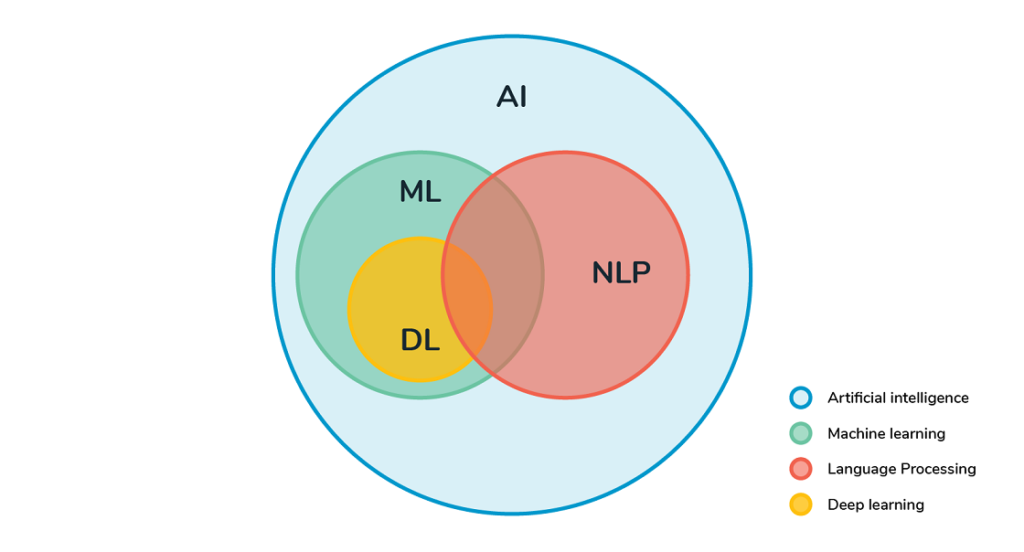
If you’re getting into AI, one of the first things that confuses people is the difference between deep learning and natural language processing. Are they the same thing? Is one a part of the other? Can you use both together?
The short answer: they’re related but distinct. Deep learning is a technique. Natural language processing is a problem domain. And understanding how they differ — and how they work together — is fundamental to building real AI systems.
Let’s break it down properly.
Table of Contents
- Quick Answer: Deep Learning vs Natural Language Processing
- What is Deep Learning?
- What is Natural Language Processing?
- Key Difference Between Deep Learning and Natural Language Processing
- How Deep Learning Powers Modern NLP
- Deep Learning vs NLP: Real Code Comparison
- When to Use Deep Learning vs NLP Techniques
- How They Work Together in Production
- FAQs
Quick Answer: Deep Learning vs Natural Language Processing
Before diving deep, here’s the one-line summary:
Deep Learning is a method — a way of building and training models using neural networks.
Natural Language Processing is a field — the problem of teaching machines to understand human language.NLP is the what. Deep learning is often the how.
Think of it like this: NLP is the goal (understand text), and deep learning is one of the tools used to achieve it. You can do NLP without deep learning (using rules or classical ML), but modern NLP is almost entirely powered by deep learning.
What is Deep Learning?
Deep learning is a subset of machine learning that uses neural networks with many layers (hence “deep”) to learn patterns directly from raw data — without manual feature engineering.
Each layer in a deep neural network learns increasingly abstract representations:
- Layer 1 might learn edges in an image
- Layer 5 might learn shapes
- Layer 20 might learn faces
This hierarchical representation learning is what makes deep learning so powerful across vision, audio, and language tasks.
Core Deep Learning Architectures
Architecture Full Name Best For CNN Convolutional Neural Network Images, spatial data RNN Recurrent Neural Network Sequences, time series LSTM Long Short-Term Memory Long sequences, text Transformer — Text, images, multimodal GAN Generative Adversarial Network Image generation Autoencoder — Compression, anomaly detection Deep Learning in Action — Image Classification
# pip install tensorflow
import tensorflow as tf
from tensorflow.keras import layers, models

# Simple CNN for image classification
model = models.Sequential([
    layers.Conv2D(32, (3, 3), activation='relu', input_shape=(28, 28, 1)),
    layers.MaxPooling2D((2, 2)),
    layers.Conv2D(64, (3, 3), activation='relu'),
    layers.MaxPooling2D((2, 2)),
    layers.Flatten(),
    layers.Dense(64, activation='relu'),
    layers.Dense(10, activation='softmax')  # 10 classes
])

model.compile(optimizer='adam',
              loss='sparse_categorical_crossentropy',
              metrics=['accuracy'])

model.summary()
# Output:

Model: "sequential"
_________________________________________________________________
 Layer (type)                Output Shape              Param #
=================================================================
 conv2d (Conv2D)             (None, 26, 26, 32)        320
 max_pooling2d (MaxPooling2D  (None, 13, 13, 32)       0
 conv2d_1 (Conv2D)           (None, 11, 11, 64)        18496
 max_pooling2d_1 (MaxPooling  (None, 5, 5, 64)         0
 flatten (Flatten)           (None, 1600)              0
 dense (Dense)               (None, 64)                102464
 dense_1 (Dense)             (None, 10)                650
=================================================================
Total params: 121,930
Notice: this is a vision task — no language involved. Deep learning works on images, audio, video, tabular data — not just text. That’s a key point in understanding the difference between deep learning and natural language processing.
What is Natural Language Processing?
Natural Language Processing (NLP) is the branch of AI focused specifically on enabling computers to read, understand, interpret, and generate human language — both text and speech.
NLP is concerned with questions like:
- What does this sentence mean?
- Is this review positive or negative?
- What entities are mentioned in this document?
- How do I translate this from Hindi to English?
- What’s the best answer to this question?
Core NLP Tasks
| Task | Description | Example |
|---|---|---|
| Tokenization | Split text into units | “I love NLP” → [“I”, “love”, “NLP”] |
| POS Tagging | Label grammatical roles | “runs” → VERB |
| NER | Find named entities | “Apple” → ORG |
| Sentiment Analysis | Detect emotion/opinion | “Great product!” → Positive |
| Machine Translation | Translate between languages | EN → HI |
| Text Summarization | Condense long text | Article → 3-line summary |
| Question Answering | Answer natural language questions | “Who founded Tesla?” → “Elon Musk” |
| Text Generation | Generate coherent text | Prompt → paragraph |
NLP in Action — Sentiment Analysis
# pip install textblob
from textblob import TextBlob

texts = [
    "The new transformer model is absolutely groundbreaking.",
    "This deep learning framework is too complicated to use.",
    "NLP has completely changed how we interact with machines."
]

for text in texts:
    blob = TextBlob(text)
    polarity = blob.sentiment.polarity
    label = "Positive" if polarity > 0.05 else "Negative" if polarity < -0.05 else "Neutral"
    print(f"Text    : {text}")
    print(f"Polarity: {polarity:.3f} → {label}\n")
# Output
Text : The new transformer model is absolutely groundbreaking.
Polarity: 0.400 → Positive
Text : This deep learning framework is too complicated to use.
Polarity: -0.175 → Negative
Text : NLP has completely changed how we interact with machines.
Polarity: 0.000 → NeutralPure NLP — no deep learning involved here. This is classical, lexicon-based NLP using TextBlob.
Key Difference Between Deep Learning and Natural Language Processing
This is the heart of the article. Here’s a comprehensive side-by-side breakdown of the difference between deep learning and natural language processing:
| Dimension | Deep Learning | Natural Language Processing |
|---|---|---|
| What it is | A technique / methodology | A field / problem domain |
| Scope | Broad — vision, audio, text, tabular | Specific — human language only |
| Goal | Learn representations from raw data | Enable machines to understand language |
| Input data | Images, audio, video, text, numbers | Text and speech |
| Core tools | Neural networks, backpropagation | Tokenizers, parsers, language models |
| Can work without the other? | Yes — image classification needs no NLP | Yes — rule-based NLP needs no DL |
| Modern relationship | Powers modern NLP | Uses deep learning as its engine |
| Example task | Detecting tumors in X-rays | Extracting diagnosis from clinical notes |
| Key algorithms | CNNs, RNNs, Transformers, GANs | BERT, GPT, Word2Vec, TF-IDF, CRF |
| Frameworks | TensorFlow, PyTorch, Keras | NLTK, spaCy, Hugging Face |
How Deep Learning Powers Modern NLP
This is where the two fields intersect most powerfully. Before deep learning, NLP relied heavily on:
- Hand-crafted linguistic rules
- Statistical methods (TF-IDF, n-grams)
- Classical ML (Naive Bayes, SVM)
These worked — but had hard limits. They couldn’t capture context, long-range dependencies, or nuance.
Deep learning changed everything through three key breakthroughs:
1. Word Embeddings (2013)
Word2Vec showed that words could be represented as dense vectors where meaning is preserved geometrically. king - man + woman ≈ queen. This was the first time deep learning truly powered NLP at scale.
2. RNNs and LSTMs (2014–2016)
Recurrent networks could process text sequentially, maintaining a “memory” of what came before. This enabled machine translation and sequence labeling at a new level of accuracy.
3. Transformers and Attention (2017–present)
The transformer architecture — with its self-attention mechanism — allowed models to relate every word to every other word in a sentence simultaneously. This gave birth to BERT, GPT, and eventually ChatGPT and Claude. Modern NLP is essentially applied deep learning.
# Deep learning powering NLP — transformer sentiment analysis
# pip install transformers torch
from transformers import pipeline

# This is deep learning (a fine-tuned BERT model) solving an NLP task (sentiment)
sentiment_pipeline = pipeline("sentiment-analysis",
                               model="distilbert-base-uncased-finetuned-sst-2-english")

texts = [
    "Deep learning has revolutionized natural language processing.",
    "I still prefer rule-based NLP for simple keyword tasks.",
    "The difference between deep learning and NLP is often misunderstood."
]

for text in texts:
    result = sentiment_pipeline(text)[0]
    print(f"Text  : {text[:60]}")
    print(f"Result: {result['label']} ({result['score']:.2%} confidence)\n")
# Output
Text : Deep learning has revolutionized natural language processing.
Result: POSITIVE (99.87% confidence)
Text : I still prefer rule-based NLP for simple keyword tasks.
Result: POSITIVE (56.23% confidence)
Text : The difference between deep learning and NLP is often misun
Result: NEGATIVE (53.41% confidence)Same NLP task (sentiment), but now powered by a deep learning model (DistilBERT) instead of TextBlob’s lexicon. The accuracy difference in production is dramatic.
Deep Learning vs NLP: Real Code Comparison
Let’s do a direct comparison — same task (text classification), solved with classical NLP first, then deep learning.
Approach 1: Classical NLP (TF-IDF + Naive Bayes)
from sklearn.feature_extraction.text import TfidfVectorizer
from sklearn.naive_bayes import MultinomialNB
from sklearn.pipeline import Pipeline

# Training data
train_texts = [
    "I love this product",
    "Terrible quality",
    "Absolutely fantastic",
    "Worst purchase ever",
    "Really happy with it",
    "Complete waste of money"
]
train_labels = ["positive", "negative", "positive",
                "negative", "positive", "negative"]

# Classical NLP pipeline — no deep learning
nlp_pipeline = Pipeline([
    ('tfidf', TfidfVectorizer()),
    ('clf', MultinomialNB())
])

nlp_pipeline.fit(train_texts, train_labels)

test = ["This is amazing!", "I regret buying this"]
preds = nlp_pipeline.predict(test)

for text, pred in zip(test, preds):
    print(f"'{text}' → {pred}")
# Output
'This is amazing!' → positive
'I regret buying this' → negativeApproach 2: Deep Learning NLP (LSTM)
import numpy as np
from tensorflow.keras.models import Sequential
from tensorflow.keras.layers import Embedding, LSTM, Dense
from tensorflow.keras.preprocessing.text import Tokenizer
from tensorflow.keras.preprocessing.sequence import pad_sequences

# Same data
train_texts = [
    "I love this product",
    "Terrible quality",
    "Absolutely fantastic",
    "Worst purchase ever",
    "Really happy with it",
    "Complete waste of money"
]
train_labels = [1, 0, 1, 0, 1, 0]  # 1=positive, 0=negative

# Tokenize
tokenizer = Tokenizer(num_words=100)
tokenizer.fit_on_texts(train_texts)
X = pad_sequences(tokenizer.texts_to_sequences(train_texts), maxlen=10)
y = np.array(train_labels)

# Deep learning model
model = Sequential([
    Embedding(input_dim=100, output_dim=8, input_length=10),
    LSTM(16),
    Dense(1, activation='sigmoid')
])

model.compile(optimizer='adam', loss='binary_crossentropy', metrics=['accuracy'])
model.fit(X, y, epochs=20, verbose=0)

# Predict
test_texts = ["This is amazing!", "I regret buying this"]
X_test = pad_sequences(tokenizer.texts_to_sequences(test_texts), maxlen=10)
predictions = model.predict(X_test, verbose=0)

for text, pred in zip(test_texts, predictions):
    label = "positive" if pred[0] > 0.5 else "negative"
    print(f"'{text}' → {label} ({pred[0]:.2f})")
'This is amazing!' → positive (0.81)
'I regret buying this' → negative (0.23)Same task. Same result on simple examples. But at scale with millions of samples — the deep learning approach wins by a large margin, because it learns richer representations of language.
When to Use Deep Learning vs NLP Techniques
Choosing the right approach depends on your use case:
Use classical NLP techniques when:
- Dataset is small (under 10K samples)
- Interpretability is required (compliance, legal)
- Speed and low compute matter
- Task is simple (keyword matching, basic classification)
- You need quick prototyping
Use deep learning for NLP when:
- Large dataset available (100K+ samples)
- High accuracy is critical
- Task is complex (translation, QA, generation)
- You can afford GPU compute
- You want to fine-tune a pre-trained model (BERT, GPT)
Use pre-trained LLMs when:
- You have little or no labeled data
- Task needs reasoning or instruction-following
- You want zero-shot or few-shot performance
- Speed to production matters more than full control
How They Work Together in Production
In real-world AI systems, deep learning and NLP don’t compete — they collaborate. Here’s what a production NLP pipeline typically looks like:
User Input (raw text)
↓
NLP Preprocessing (tokenization, normalization) ← classical NLP
↓
Embedding Layer (Word2Vec / subword tokenizer) ← deep learning
↓
Transformer Encoder (BERT / RoBERTa) ← deep learning
↓
Task-Specific Head (classifier / NER / QA) ← deep learning
↓
Post-processing (entity linking, formatting) ← classical NLP
↓
Output
The classical NLP steps handle the edges (input cleaning, output formatting). Deep learning handles the heavy lifting in the middle.
Conclusion
The difference between deep learning and natural language processing comes down to this: NLP is the problem, deep learning is increasingly the solution. They’re not competing — they’re complementary.
Classical NLP techniques (tokenization, TF-IDF, rule-based parsing) are still valuable for lightweight tasks, interpretable systems, and data-scarce scenarios. But for anything requiring real language understanding at scale — deep learning, and specifically transformer-based models, is the way forward.
Understanding both gives you the flexibility to pick the right tool for the right job — and that’s what separates good AI engineers from great ones.
FAQs
1. What is the main difference between deep learning and natural language processing?
Deep learning is a machine learning technique that uses multilayered neural networks to learn from data. Natural language processing is a field of AI focused on enabling machines to understand human language. Deep learning is a method; NLP is a domain. Modern NLP uses deep learning as its primary engine.
2. Is NLP a subset of deep learning?
No — it’s actually the other way around in practice. Deep learning is a subset of machine learning, and NLP is a field that uses both classical ML and deep learning techniques. Modern NLP heavily relies on deep learning, but NLP as a concept existed long before deep learning.
3. Can you do NLP without deep learning?
Yes. Classical NLP uses rule-based systems, statistical models, and algorithms like TF-IDF, Naive Bayes, and CRFs. These work well for simple tasks with small datasets. However, for complex tasks like machine translation, question answering, or text generation, deep learning models dramatically outperform classical approaches.
4. What deep learning architectures are used in NLP?
The most important ones are: RNNs and LSTMs (for sequential text processing), Transformers (the foundation of BERT, GPT, and all modern LLMs), and Word2Vec/GloVe embeddings (for representing words as vectors). Transformers have largely replaced RNNs in modern NLP systems.
5. What is the relationship between BERT, GPT and NLP?
BERT and GPT are deep learning models — specifically transformer-based architectures — trained on massive text datasets to solve NLP tasks. They represent the state of the art in applying deep learning to natural language processing. BERT is optimized for understanding tasks (classification, NER, QA); GPT is optimized for generation tasks.
6. Which should I learn first — deep learning or NLP?
Learn NLP fundamentals first (tokenization, embeddings, basic text classification), then build your deep learning foundations (neural networks, backpropagation, CNNs/RNNs), then combine them by studying transformer-based NLP. This path gives you the strongest intuition for both fields.
Related reading on Nomidl: What is Natural Language Processing? — the complete NLP fundamentals guide. Also see How Does Natural Language Processing Work? for a deep dive into the NLP pipeline. For hands-on practice, check out Sentiment Analysis using TextBlob.
External reference: Hugging Face documentation — best resource for transformer-based NLP models.
Popular Posts
- Build and Evaluate a RAG Pipeline with RAGAS, LangChain, FAISS, and Groq (Step-by-Step Guide)
- Loop Engineering Explained: From Prompt Engineering to Self-Prompting AI Agents
- Build Your First MCP Server with FastMCP: A Complete Python Tutorial
- MCP vs Function Calling: Key Differences Explained (2026)
- What Is Model Context Protocol (MCP) – A Complete Guide for AI Developers