Category: Python
 Rajesh Yerremshetty
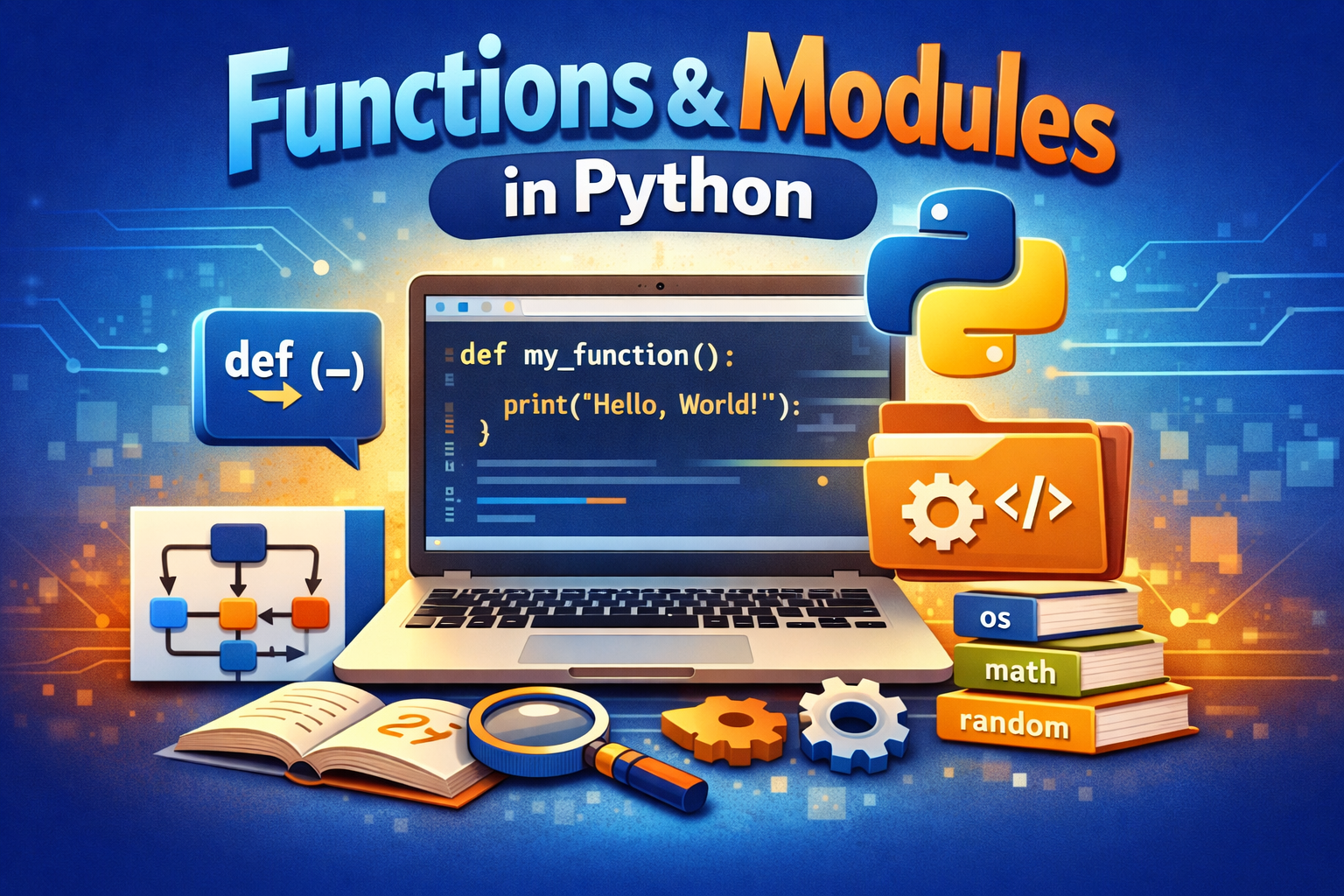
Zero to Python Hero – Part 6/10: Functions and Modules in Python
The main concepts of Python programming are functions and modules. They enable us to separate code into smaller, reusable and more structured units to enhance readability and maintainability. Functions and modules assist in organizing logic and workflows just the way data structures can assist in the storage and arrangement of data. This article shall discuss…
Read More
Zero to Python Hero – Part 5/10: Essential Data Structures in Python: Lists, Tuples, Sets & Dictionaries
The fundamental way of storing, accessing and manipulating of data in python is data structures. Python provides an convenient and adaptable collection of objects to store and data and sort it in different ways, be it a list, a tuple, a dictionary or a set. In the current article, we will go through the most…
Read More
 Naveen Pandey
Zero to Python Hero - Part 2/10 : Understanding Python Variables, Data Types (with Code Examples)
Learning Python can feel overwhelming when you’re starting from scratch. I discovered this firsthand while researching about the Python resources online. As I went through countless tutorials, documentation pages, and coding platforms, I realized a frustrating truth: beginners often have to jump between multiple websites, books, and resources just to understand the basics. Even worse,…
Read More
How to Remove Duplicates from a List in Python
In this article, we will learn how to remove duplicates from a list in Python. We have a list of names that contains duplicate entries, and our goal is to remove these additional names efficiently. While one approach could be to iterate through the list multiple times and check the frequency of each name, this…
Read More
How to use *args and **kwargs in Python
I have come to see that most new Python programmers have a hard time figuring out the *args and **kwargs magic variables. So what are they?First of all, let me tell you that it is not necessary to write *args or **kwargs specifically. Only the * (asterisk) is necessary. You could also write *var and…
Read More
Top Programming Languages for Data Science in 2024
Data science is the art of discovering patterns and hidden gems within vast data oceans. Think of it as being a detective of the digital age, unraveling mysteries using numbers, algorithms, and technology. Just like a detective needs the right tools, data scientists in 2024 also rely on a toolkit of powerful programming languages to…
Read More
Denoising Images with Autoencoders Using TensorFlow and Python
In today’s digital world, images play an important role in various applications, from medical imaging to self-driving cars. However, images are often corrupted by noise during transmission or storage, which can hinder the performance of image processing algorithms. In this blog post, we will explore how to use autoencoders to denoise images. We will implement…
Read More
How to Use the Else Block in For and While Loops in Python
In this article, we will explore the uncommon syntax of the else block in both for and while loops. Understanding this difference is important before using it in your programs. We will look at the two sample programs: one using a for loop and another using a while loop. For Loop Example To create a…
Read More
How to use isinstance() Function in Python | isinstance() in Python
In this article, we will explore the isinstance() function, which is a built-in function in Python. This function is commonly used by professionals to compare two different data types and determine whether they are the same or not. By using isinstance(), we can easily check if a variable is of a specific data type before…
Read More
Deque : Memory Efficient Alternative To Python Lists
In this blog, we will be covering deque, which stands for Double Ended Queue in Python. We will explore why this data structure is very useful, especially when managing a stack in Python. We will go over the methods that come with the Double Ended Queue and how we can use it to handle queues…
Read More
11 Tips to Instantly Improve Your Python Code
Python is a powerful programming language known for its simplicity and readability. In this article, we will explore 11 tips that can instantly improve your Python code. These tips include best practices that make your code cleaner and more pythonic. Tip 1: Iterate with `enumerate` instead of `range(len())` When you need to iterate over a…
Read More
Efficient Data Manipulation with Apply() Function in Pandas
If you’re a data enthusiast like me, you’ve probably dabbled in the world of Python and Pandas, the go-to library for data manipulation and analysis. Now, imagine you have a massive dataset with thousands of rows, and you want to perform some custom operations on it. Well, don’t fret! Pandas has your back, and it…
Read MoreFeatured Articles
-
 Zero to Python Hero – Part 5/10: Essential Data Structures in Python: Lists, Tuples, Sets & Dictionaries
-
Top 5 Skills Every Engineer Should Learn in 2026
-
Zero to Python Hero - Part 4/10 : Control Flow: If, Loops & More (with code examples)
-
Zero to Python Hero - Part 3/10 : Understanding Type Casting, Operators, User Input and String formatting (with Code Examples)
-
Dynamic Programming in Reinforcement Learning: Policy and Value Iteration





Latest Articles
-
Context Engineering: The Secret Behind Every AI Conversation
-
Zero to Python Hero – Part 6/10: Functions and Modules in Python
-
Zero to Python Hero – Part 5/10: Essential Data Structures in Python: Lists, Tuples, Sets & Dictionaries
-
Top 5 Skills Every Engineer Should Learn in 2026
-
Zero to Python Hero - Part 4/10 : Control Flow: If, Loops & More (with code examples)
-
Zero to Python Hero - Part 3/10 : Understanding Type Casting, Operators, User Input and String formatting (with Code Examples)