
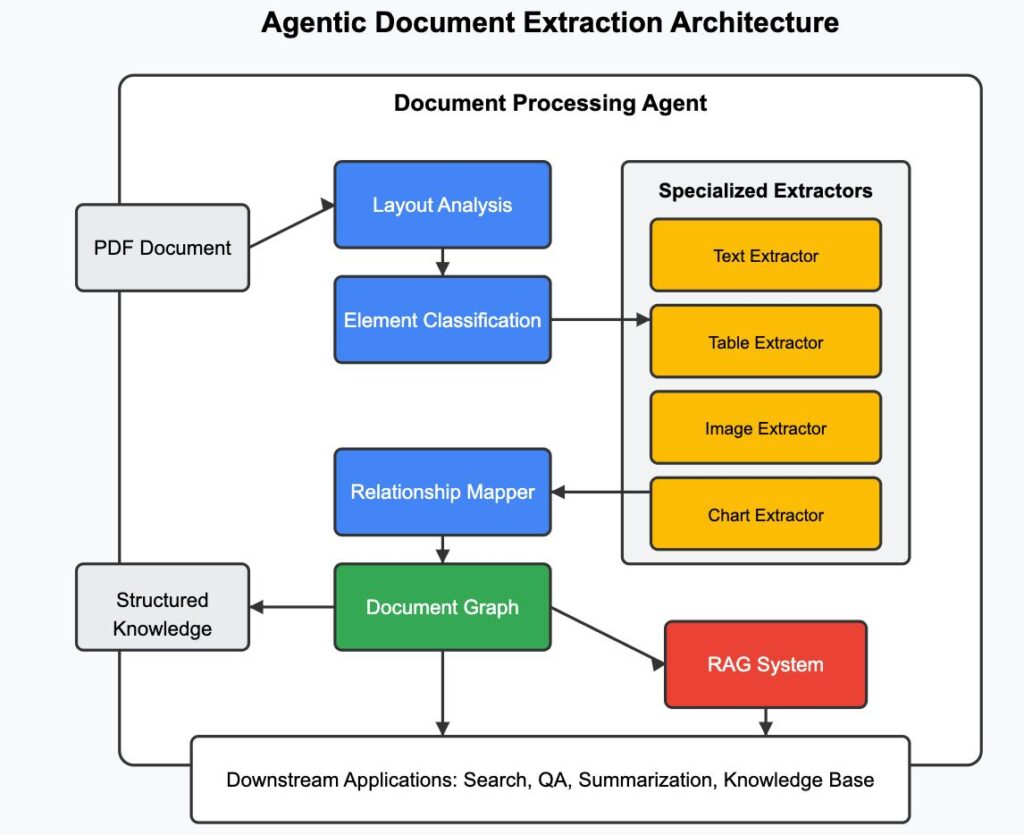
Traditional RAG systems retrieve information. Modern AI systems decide how to respond. That shift—from retrieval to reasoning—is what defines the next generation of intelligent systems.
In this article, we build a Multi-Agent Multimodal RAG system that not only retrieves knowledge but also decides whether to respond with text, generate a structured diagram, or produce a visual image. This system combines LLMs, vector search, and multiple generation tools into a unified pipeline, making it far closer to real-world AI applications than standard tutorials.
From practical experience building LLM systems, the biggest limitation of basic RAG pipelines is clear: they are static. They always follow the same steps regardless of the query. What we need instead is a system that can reason, choose tools, and adapt its behavior dynamically. That is exactly what we will build here.
What is Multimodal RAG and why is it not enough anymore?
Retrieval-Augmented Generation (RAG) is a technique that improves LLM responses by retrieving relevant information from external sources. Instead of relying only on pre-trained knowledge, the model uses retrieved context to generate more accurate answers.
In a multimodal setup, the system extends beyond text and incorporates other data types such as images. However, most implementations treat images as text by extracting their content using OCR or captions. While this allows the system to process visual data, the output remains limited to text.
This is where traditional multimodal RAG falls short. It can understand multiple modalities, but it cannot respond in multiple modalities. In real-world applications, users often expect not just explanations, but visual representations—diagrams, illustrations, and structured outputs that enhance understanding.
What is Agentic Multimodal RAG?
Agentic Multimodal RAG builds on top of traditional RAG by introducing decision-making and tool usage. Instead of following a fixed pipeline, the system uses agents to determine how to respond to a query.
In this architecture, the system does not assume that every query needs the same type of output. Instead, it analyzes the query and decides whether the response should include:
- only text
- a structured diagram
- a generated image
This transforms the system from a passive responder into an active problem-solving agent.
System Architecture: How everything works together
At a high level, the system follows a coordinated workflow.
When a user submits a query, the first component that activates is the tool selection agent. This agent analyzes the query and determines whether a visual output is required. If the query involves structured processes or architectures, the system generates a diagram. If the query is more conceptual, it produces an illustrative image. Otherwise, it responds with text only.
Once the decision is made, the system retrieves relevant context using a vector database. This ensures that the response is grounded in real information rather than relying solely on the model’s internal knowledge.
The retrieved context is then passed to the language model, which generates a clear and structured answer. Finally, depending on the decision made earlier, the system generates either a diagram using Mermaid or an image using a diffusion model.
Why diagrams and images require different approaches
A key insight in building this system is understanding that not all visuals are the same.
Diffusion models, such as Stable Diffusion, are excellent at generating creative and realistic images. However, they struggle with structured outputs like diagrams, flowcharts, and labeled architectures. This is because they are trained to optimize visual realism rather than logical structure.
For structured visuals, programmatic tools like Mermaid are far more reliable. They generate diagrams based on explicit instructions, ensuring accuracy and readability.
This is why the system separates visual generation into two paths: structured diagrams and conceptual images.
Step-by-Step Implementation
Now let’s build the system step by step.
Setting up the environment
!pip install -q groq sentence-transformers faiss-cpu diffusers transformers accelerate
import os
from getpass import getpass
os.environ["GROQ_API_KEY"] = getpass("Enter Groq API Key: ")
Initializing models
from groq import Groq
from sentence_transformers import SentenceTransformer
from diffusers import StableDiffusionPipeline
import torch
client = Groq()
embedding_model = SentenceTransformer("all-MiniLM-L6-v2")
pipe = StableDiffusionPipeline.from_pretrained("runwayml/stable-diffusion-v1-5")
pipe = pipe.to("cuda" if torch.cuda.is_available() else "cpu")
Creating the knowledge base
documents = [
   "Transformers use self-attention mechanisms.",
   "RAG retrieves external knowledge before answering.",
   "Multi-agent systems divide tasks across agents."
]
import faiss
import numpy as np
embeddings = embedding_model.encode(documents)
index = faiss.IndexFlatL2(embeddings.shape[1])
index.add(np.array(embeddings))
Building the tool selection agent
def tool_selector_agent(query):
   prompt = f"""
   Classify the query:
   - diagram → structured explanation
   - image → conceptual visual
   - none → no visual needed
   Query: {query}
   """
   response = client.chat.completions.create(model="openai/gpt-oss-120b",
       messages=[{"role": "user", "content": prompt}]
   )
   return response.choices[0].message.content.lower()
Retrieval and text generation
def retriever(query):
   query_embedding = embedding_model.encode([query])
   _, I = index.search(np.array(query_embedding), 2)
   return [documents[i] for i in I[0]]
def text_agent(query, context):
   prompt = f"""
   Answer clearly using the context.
   Context:
   {context}
   Question:
   {query}
   """
   response = client.chat.completions.create(
       model="openai/gpt-oss-120b",
       messages=[{"role": "user", "content": prompt}]
   )
   return response.choices[0].message.content
Diagram generation (Mermaid)
from IPython.display import Markdown, display
def diagram_agent(query):
   prompt = f"""
   Convert this into a Mermaid diagram.
   Query: {query}
   """
   response = client.chat.completions.create(
       model="openai/gpt-oss-120b",
       messages=[{"role": "user", "content": prompt}]
   )
   code = response.choices[0].message.content
   display(Markdown(f"```mermaid\n{code}\n```"))
Image generation (Diffusion)
def image_prompt_agent(query):
   prompt = f"""
   Create a clean, minimal image prompt.
   No text, no labels, professional style.
   Query: {query}
   """
   response = client.chat.completions.create(
       model="openai/gpt-oss-120b",
       messages=[{"role": "user", "content": prompt}]
   )
   return response.choices[0].message.content
def image_agent(prompt):
   image = pipe(prompt).images[0]
   display(image)
Final orchestrator
def hybrid_rag_system(query):
   tool = tool_selector_agent(query)
   docs = retriever(query)
   context = " ".join(docs)
   answer = text_agent(query, context)
   print("\nAnswer:\n", answer)
   if "diagram" in tool:
       diagram_agent(query)
   elif "image" in tool:
       prompt = image_prompt_agent(query)
       image_agent(prompt)
Example usage
hybrid_rag_system("Explain transformer architecture")
hybrid_rag_system("Show an AI brain concept")
hybrid_rag_system("What is RAG?")
What makes this system different?
This system is fundamentally different from traditional RAG pipelines because it introduces decision-making and adaptability. Instead of treating every query the same way, it dynamically selects the appropriate response format.
It also separates visual generation into structured and creative outputs, ensuring that diagrams remain accurate while images remain visually meaningful.
Most importantly, it reflects how modern AI systems are actually built—by combining multiple specialized components rather than relying on a single model.
Conclusion
The evolution from RAG to Agentic Multimodal RAG represents a shift from static pipelines to intelligent systems. It is no longer enough for AI to retrieve and generate text. It must also decide how to present information in the most effective way.
By combining retrieval, reasoning, and multimodal generation, this system demonstrates how AI can move closer to real-world problem solving. It is not just about answering questions anymore—it is about delivering answers in the most useful form possible.
Popular Posts
- Build and Evaluate a RAG Pipeline with RAGAS, LangChain, FAISS, and Groq (Step-by-Step Guide)
- Loop Engineering Explained: From Prompt Engineering to Self-Prompting AI Agents
- Build Your First MCP Server with FastMCP: A Complete Python Tutorial
- MCP vs Function Calling: Key Differences Explained (2026)
- What Is Model Context Protocol (MCP) – A Complete Guide for AI Developers