
Generative AI is used to create, whereas Agentic AI is used to finish. Generative AI is sufficient, in case you are just in need of text, code, or images. However, when you want to automatize procedures, make decisions and conduct multi-step processes, the appropriate solution is Agentic AI.
This difference is made apparent in a much shorter period of time than when it comes to constructing LLM-based applications and trying out agent frameworks. Generative AI is brilliant in generating answers, and it does not go beyond that. Instead, agentic AI persists beyond the response and is geared towards the achievement of an end. The next stage of artificial intelligence is that change, the shift between answering and acting.
What does the Generative AI mean and why is it that powerful?
Generative AI is a form of artificial intelligence that generates new content by relying on the patterns observed in large datasets. It is capable of producing human like text, writing codes, drawing pictures and it can also compose music. It is that it has been trained on enormous volumes of data, and can reproduce patterns with stunning precision; that is why it seems intelligent.
On a more fundamental level, the Generative AI involves the prediction of a following word (or token) in a sequence. Upon giving a prompt, the model examines the context and forms a response as the most likely continuation. This process is very quick and the outputs are natural and coherent.
Nevertheless, Generative AI has a very narrow scope of operations, regardless of the capabilities it possesses. It is simple in nature, you provide an input and the output is provided. It has nothing like internal planning or memory of prior steps or communication with external systems that it is not explicitly programmed. It does not authenticate information, retrieve real time information, or perform tasks automatically.
That is why Generative AI is most appropriate in such jobs as writing blogs, summarizing documents, creating code snippets, or writing marketing content. It is better in situations when it is possible to solve the problem at once.
What is Agentic AI and what is the difference?
The Agentic AI builds on the abilities of Generative AI and builds upon it a lot more powerful. Rather than just creating responses, Agentic systems of AI are created to accomplish goals. They are able to plan things, act upon it, work with tools and repeat it until one achieves the goal.
Simply put, Agentic AI transforms a language model into a thinking acting system.
An Agentic AI system is not attempting to solve everything simultaneously when given a task. Rather, it divides the problem into smaller steps. It determines the first step that should be undertaken, the tools to be used, actions to be performed and the assessments of the outcome. In case the goal is not attained, the process is repeated until it attains it.
To take the example of a Generative AI model, when you give it the task of creating a research report, it will create a general response based on its training data. However, an Agentic AI system will not do the same. It can find the most recent databases, derive the appropriate insight, extract the data, calculate the data, and produce a well-structured report. It is more likely to act as a human trying to work out a problem than a system that produces text.
This capability to support multi-step processes is what makes Agentic AI absolutely different.
What is the difference between Generative AI and Agentic AI?
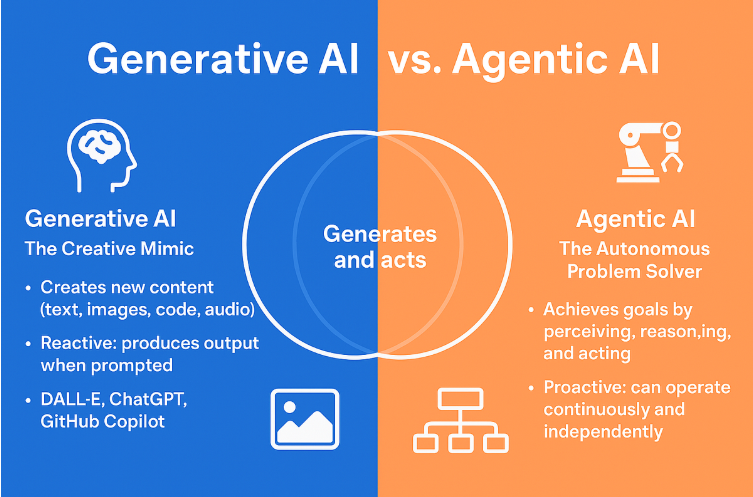
The easiest distinguishing difference is as follows: Generative AI generates outputs, whereas Agentic AI generates outcomes.
Generative AI is reactive. Waits waiting till there is a prompt, and acts. The process concludes after generating the response. It fails to make initiative and further work after that.
Agentic AI is proactive. It gets an objective and strives to achieve it. It has the right to determine what to do, consult external tools, and work on the strategy provided with feedback input. It does not end with an answer, but rather aims at an outcome.
This distinction is of particular significance in practice. Composing a code of writing is a nice thing, but running, testing, and debugging of a code is what provides the value. The former can be supported by generative AI, whereas the latter can address the whole process through the use of Agentic AI.
What is the mechanism of Generative AI and Agentic AI?
Generative AI is a one-step technology. This model is fed, processed and the output is generated. No iteration/ feedback loop is involved. It all takes place in a single pass.
However, agentic AI functions as a loop.
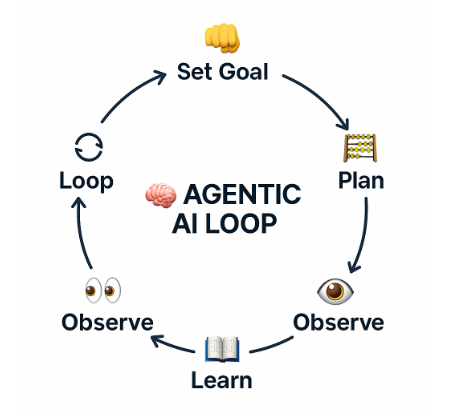
The system starts with the understanding of the goal. It further develops a plan by innovating the task into small steps. Then, it carries out the actions with the help of available tools, monitors the outcome, and forms the next steps. This process goes on until an objective is realized.
It is influenced by classical AI agent theory, wherein systems interact both with the environment, act and get better through feedback. The combination of this concept and contemporary language models leads to the development of intelligent and executionable systems of Agentic AI.
Why should memory and tools be of interest in Agentic AI?
The lack of memory is one of the largest constraints of Generative AI. Every interaction is autonomous and the model does not store information unless that information is contained in the prompt. This renders it hard to manage activities which need continuity or long term surroundings.
This is solved by agentic AI through the introduction of memory systems. These systems enable the agent to archive past actions, recall pertinent information and keep track of the context during the process of work. This allows one to deal with complicated multi-step tasks with ease.
Tools are equally important. The absence of tools makes an AI system only able to produce text. It can actively engage with the real world with tools. It is able to search the internet, query databases, execute code or make API calls. This turns this system into a the reactive generator into a proactive problem solver.
The rationality, memory, and tools are what make Agentic AI powerful.
In which cases will you use Generative AI and in which cases will you use Agentic AI?
When the task is reasonably simple and consists of content creation, the right option is generative AI. Generative AI is quick, efficient, and simple to operate in the event that you require writing an article, creating code, or summarizing information.
Use of agentic AI is necessitated when the task has several steps or the task entails making decisions. When you are creating a system, and it requires my data to be acquired, processed, and results to be obtained, you cannot rely on a simple Generative AI model. You require a coordinator that will coordinate the workflow.
The most practical systems in reality usually embody a combination of the two methods. Generative AI is in charge of the reasoning and generation of language, whereas the Agentic AI takes care of execution and coordination.
Code Example: Generative AI vs Agentic AI
To make this difference more concrete, let’s look at two simple examples.
Generative AI Example
from transformers import pipeline
generator = pipeline(
    "text-generation",
    model="TinyLlama/TinyLlama-1.1B-Chat-v1.0",
    max_new_tokens=100
)
prompt = "Explain who invented Python."
output = generator(prompt)[0]["generated_text"]
print(output)
This example shows a typical Generative AI workflow. The model takes a prompt and generates a response. There is no planning or execution involved.
Agentic AI Example
import wikipedia
import re
from transformers import pipeline
generator = pipeline(
    "text-generation",
    model="TinyLlama/TinyLlama-1.1B-Chat-v1.0",
    max_new_tokens=120
)
def wiki_tool(query):
    try:
        return wikipedia.summary(query, sentences=2)
    except:
        return "No information found."
def calculator_tool(expression):
    try:
        return str(eval(expression))
    except:
        return "Invalid expression"
def agent(question):
    print("Question:", question)
    reasoning = generator(f"How to solve: {question}")[0]["generated_text"]
    print("\nReasoning:\n", reasoning)
    if re.search(r"[0-9]+\s*[\*\+\-/]\s*[0-9]+", question):
        expression = re.findall(r"[0-9]+\s*[\*\+\-/]\s*[0-9]+", question)[0]
        result = calculator_tool(expression)
    else:
        result = wiki_tool(question)
    print("\nFinal Answer:", result)
agent("Who invented Python and what is 25 * 17?")
In this example, the system does more than just generate text. It reasons about the problem, selects a tool, executes an action, and returns the result. This is a simplified version of how real agent systems work.
How is the distinction between Generative and Agentic AI?
This distinction between Generative and Agentic AI is further made apparent by looking at the behavior of each AI type in real world context both as opposed to each other as well as definitions. Generative AI is intended to answer prompts and Agentic AI is intended to accomplish objectives. This difference is an influencing factor on the construction of each system, on how these systems perform, and on the areas in which they can be applied.
Generative AI operates autonomously. It is fed something, processes it then produces something. After the production of output, the interaction ceases. The continuation of the thought process, the subsequent action and the realization whether the output is personally solving the problem or not is lacking. This makes it highly effective in activities such as writing, summarization or code generation, but is limited when activities need execution or validation.
On the contrary, agentic AI functions via a loop. It does not end with the initial retort. Rather, it assesses the goal achievement and goes on working in case it has not been reached. This implies that it is allowed to divide issues into steps, decisions, utilization of tools, and time refinement. In practice this will enable it to work with work that is closer to real world workflows than on single queries.
Memory is another aspect of a major difference. Generative AI systems are often stateless (they do not remember information, unless there is information in the prompt). The agentic AIs implement memory processes in which these systems can trace progress, hold results in between, and keep context across tests. This renders them much better to the challenging and prolonged tasks.
Another significant point of difference is the use of tools. Generative AI supports text generation only without further integrations that are clearly constructed. There is agentic AI that is meant to be involved with tools like APIs, databases, or code execution environments. This will help it to go beyond it produces answers and actually carry out actions in real world.
Generative AI can, in simple terms, be seen as a content engine whereas Agentic AI is a system of decision making with the ability to execute. One generates an information and the other consumes information to realise results.
How does the future appear?
The next development of artificial intelligence is agentic AI. Generative AI has revolutionized our content-making process but Agentic AI is revolutionizing our work.
We are heading towards the future when AI systems will not be assistants only but partners. They can manage intricate work packages, automate processes and facilitate decision making in sectors.
Generative AI will continue playing a significant role of base but this will be accompanied by an Agentic AI which will determine the applications of AI in actual space worlds.
Conclusion
The generative AI assists you in creating whereas the agentic AI assists you in finishing.
This is because the true worth of AI is not to have another system that aims to find better responses but create systems capable of acting and attaining objectives. With the technological changes that the technology is undergoing, the transition of the generation to execution will become even more significant.
Frequently Asked Questions (FAQ)
Q1. How does Generative AI differ fundamentally with Agentic AI?
Ans. The primary distinction lies in the fact that Generative AI generates content, whereas Agentic AI fulfils tasks. Generative AI aims to generate the output such as text or program, but Agentic AI aims to achieve the goal by planning, executing and iterating.
Q2. Is Generative AI the foundation of the Agentic AI?
Ans. Yes, Generative AI models are used in Agentic AI in reasoning and comprehending language. The generative model functions as the central intelligence, and the agent structure incorporates planning, memory and usage of tools.
Q3. What is the first one that I need to learn as a beginner?
Ans. Generative AI would be the best place to begin since it is less complicated and easier to comprehend. When you can work with prompts and models, as well as the simplest applications, you may proceed to Agentic AI, which implies designing more complicated systems.
Q4. Is it possible that Generative AI can do tasks similar to Agentic AI?
Multi-step tasks or workflows can not be done by generating AI only. It is capable of simulating text steps, but not text action. In order to conduct actual work, you require an agentic system that has the ability to interact with tools and recur towards an objective.
Q5. Does it mean that agentic AI is the new wave of AI systems?
The most popular and recognized advancement in AI is agentic AI as it makes automation possible and allows it to perform tasks in the real world. As much as Generative AI will continue to be significant, Agentic AI will also be relevant in the creation of intelligent systems that can operate on their own.
Popular Posts
- Build and Evaluate a RAG Pipeline with RAGAS, LangChain, FAISS, and Groq (Step-by-Step Guide)
- Loop Engineering Explained: From Prompt Engineering to Self-Prompting AI Agents
- Build Your First MCP Server with FastMCP: A Complete Python Tutorial
- MCP vs Function Calling: Key Differences Explained (2026)
- What Is Model Context Protocol (MCP) – A Complete Guide for AI Developers