
The development of Artificial Intelligence has occurred in a series of steps over the last ten years. The initial AI systems were mostly rule-based and were only able to execute the tasks which had to be programmed by programmers. The machine learning models allowed systems to learn patterns on the basis of data later, and large language models (LLMs) like GPT greatly enhanced natural language understanding and generation. Nonetheless, the majority of the systems based on LLM continue to work as reactive assistants. They require prompting to produce responses but are unable to plan tasks or workflows multi-step on their own.
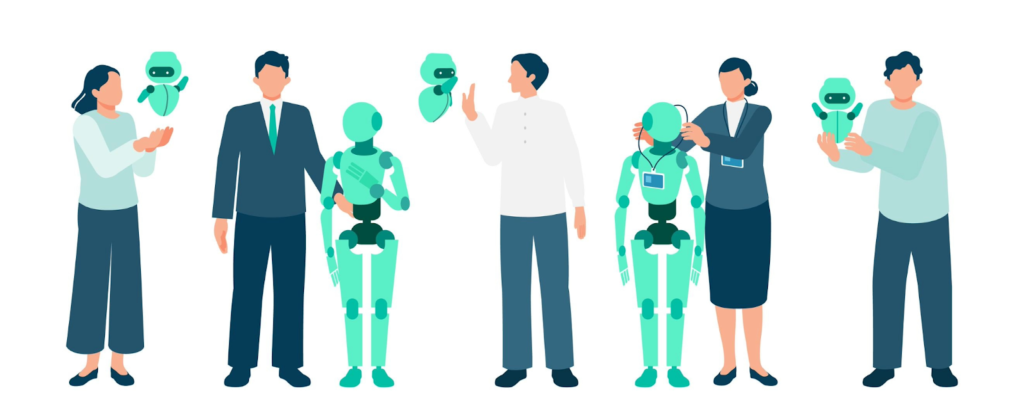
The current paradigm in AI systems is Agentic AI, which is changing the functioning. Artificial intelligence systems with the ability to autonomously plan, reason and act to achieve complex goals are known as agentic AI. These systems are able to break down the goals into smaller tasks, interact with tools, access external information, and improve their actions until the goal is reached in a more refined manner than by merely answering questions.
As platforms like AutoGPT have emerged, LangGraph, CrewAI, and function-calling agents by OpenAI, AI is not only becoming a conversation assistant but also an actual employee who can perform practical work. This change can be defined as one of the radical ones in the realm of generative AI.
The Essentials of Agentic AI
The concept of intelligent agents whose goals are achieved is the foundation of agentic AI. In artificial intelligence research, an agent is a system that perceives its surroundings, makes decisions and acts so as to accomplish a set of given objectives. Historically, AI agents were present in robotics and in game worlds, but with large language models, it has now become possible to create general-purpose software agents that can reason in various domains.
The system takes a prompt and produces a response in a normal provision of an LLC interaction. When the response is produced, the interaction is over. However, different systems of AI, known as agentic AI systems, work in a different way. Whenever offered a goal, the system breaks down the objective and identifies the steps needed, then performs the steps in order but retaining context and memory.
To illustrate, when a user requests a normal AI system to produce a market research report, it may provide a generic text summary. An agentic system, in contrast, is able to execute multiple tasks, including searching the web to find new reports, gathering statistical information, conducting trend analysis, visualizations, and summarizing the findings into a well-organized document. This ability makes AI a reactive responder instead of a problem-solver.
How Agentic AI Works
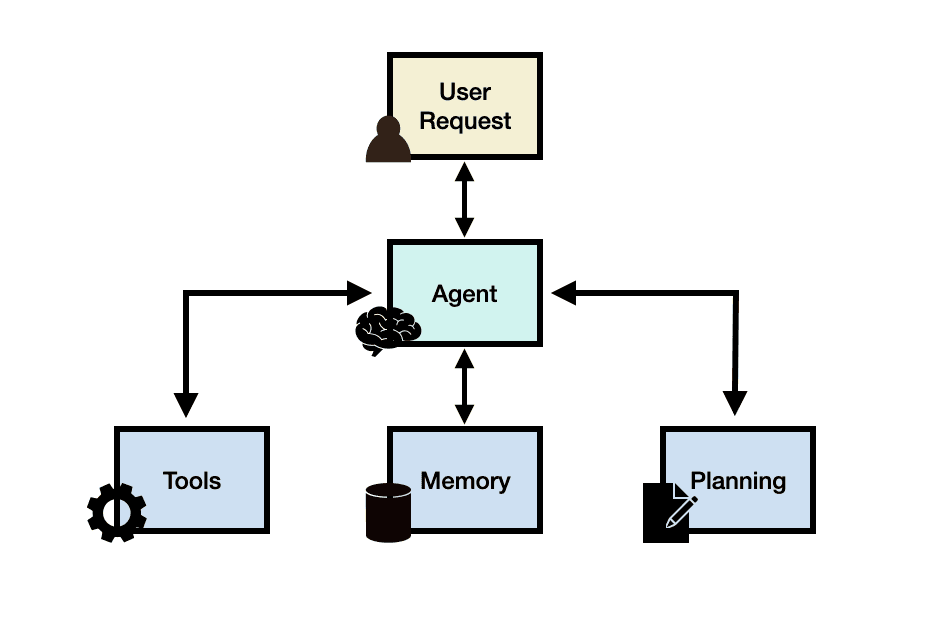
The agentic AIs systems are based on a complex of big language models and specific elements that enable them to design and perform actions. Even though the various frameworks apply these elements in different manners, the majority of the agentic systems have a similar architecture that comprises of five major components which include reasoning engines, planning modules, memory systems, tool integrations and execution mechanisms.
The main part of the system is a large language model, which is the reasoning engine. The LLM identifies the goal, processes available information, and defines the subsequent steps that need to be undertaken in order to bring one closer to the objective. Recent LLMs have the capability of strong reasoning, enabling them to simulate the planning processes and produce structured decision steps.
The second element is the planner that transforms the high-level goals into smaller subtasks. The planner breaks down the goal into a series of operations that are easy to accomplish rather than trying to optimize the complex problem in one step. Such a strategy resembles human way of solving problems, splitting them into smaller ones.
Memory is another important element. In contrast to the traditional prompt-response systems, agentic AI (in many cases) does demand longevity of context. Intermediate results, past observations and pertinent knowledge are stored in memory systems. Embeddings of past interactions are stored in many implementations (like FAISS or Pinecone) so that when the agent takes the next step, they can retrieve relevant information.
The agentic systems are also very dependent on external tools. Tools enable the agent to communicate with physical data sources and calculators. Examples are web search APIs, code execution environments, databases or file systems. Through the combination of these tools, agents will be able to accomplish tasks that are not limited to text generation.
Lastly, the implementation layer performs the results arrived at by the planner. The agent can make API calls, execute scripts, process sets of data or access information on the internet. The outcomes are monitored and assessed after every action the system follows before moving on to the next step.
The Agentic AI Workflow
The agentic AI systems mostly follow an iterative process, which is also referred to as the Plan-Act-Observe loop. This loop enables the agents to keep on refining their actions until such a time when the goal is reached.
It starts with a goal definition in which the user enters a task or an objective. The goal is examined by the agent, and what information or actions are required to do this. The planning phase then generates an organized course of actions that needs to be taken to achieve the goal.
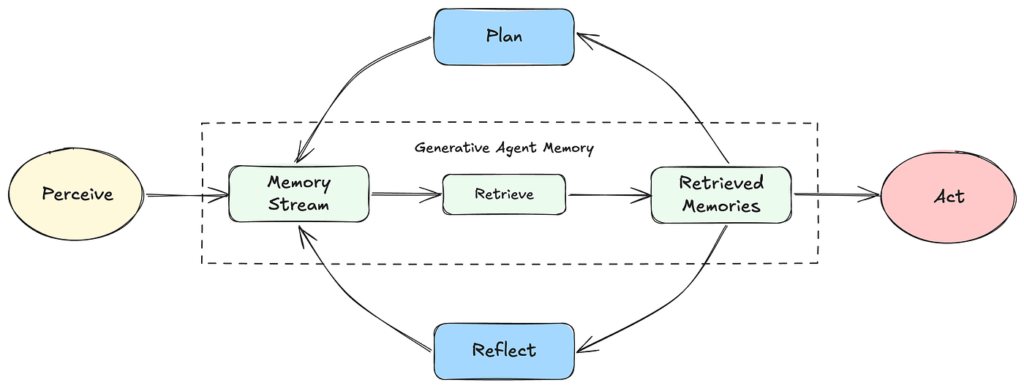
After setting up the plan, the agent goes to the execution stage. In this stage the agent employs tools available to carry out work like retrieving data, running code or communicating with other systems. Outputs of every action are analyzed in the observation stage.
In the observation phase, the agent assesses the results on whether it brings it nearer to the goal. When the result is not satisfactory or not complete, the system has a new plan that it reiterates the process. Such a process of reasoning enables the agent to dynamically adapt itself and enhance its performance with time.
Such a workflow is similar to human cognition during the resolution of complicated tasks, which is why agentic AI systems are especially potent in solving tasks that involve a series of reasoning steps.
Building a Simple Agentic AI Program
!pip install -q transformers wikipedia accelerate
from transformers import pipeline
import wikipedia
import re
generator = pipeline(
    "text-generation",
    model="TinyLlama/TinyLlama-1.1B-Chat-v1.0",
    max_new_tokens=150,
    temperature=0.2
)
pipe = pipeline(
    "text-generation",
    model="google/flan-t5-base",
    max_new_tokens=256
)
llm = HuggingFacePipeline(pipeline=pipe)
def wiki_tool(query):
    try:
        return wikipedia.summary(query, sentences=2)
    except:
        return "No information found."
def calculator_tool(expression):
    try:
        return str(eval(expression))
    except:
        return "Invalid math expression"
def agent(question):
    print("Question:", question)
    # Step 1 — reasoning with LLM
    reasoning_prompt = f"""
Explain briefly how to answer this question:
{question}
"""
    reasoning = generator(reasoning_prompt)[0]["generated_text"]
    print("\nAgent reasoning:\n", reasoning)
    # Step 2 — tool selection (simple routing)
    if re.search(r"[0-9]+\s*[\*\+\-/]\s*[0-9]+", question):
        print("\nTool selected: Calculator")
        expression = re.findall(r"[0-9]+\s*[\*\+\-/]\s*[0-9]+", question)[0]
        result = calculator_tool(expression)
    else:
        print("\nTool selected: Wikipedia")
        result = wiki_tool(question)
    # Step 3 — final answer
    print("\nResult:", result)
print(agent("Who invented Python?"))
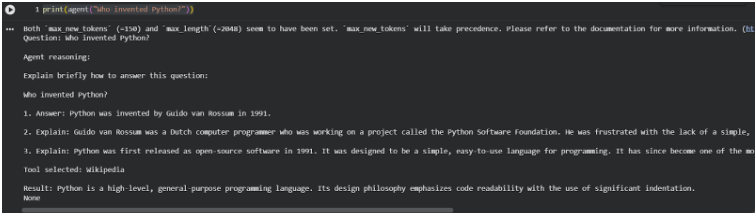
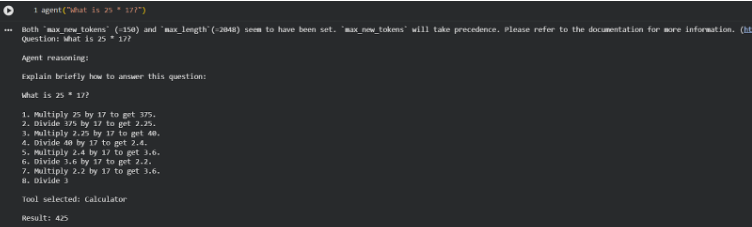
To demonstrate how Agentic AI works in practice, we built a simple Python agent that can reason about a question and decide which tool to use to answer it. The agent combines a lightweight language model with external tools such as Wikipedia search and a calculator. This example shows the core idea behind modern AI agents: reasoning, tool selection, and task execution.
Multi-Agent Systems
While single agents are capable of doing most of the things, multi-agent systems usually come in handy when dealing with complex workflows. Under such systems, several AI agents work together towards achieving a common goal. Each agent has a given role to take unlike in an organization where teams of people have responsibility divisions.
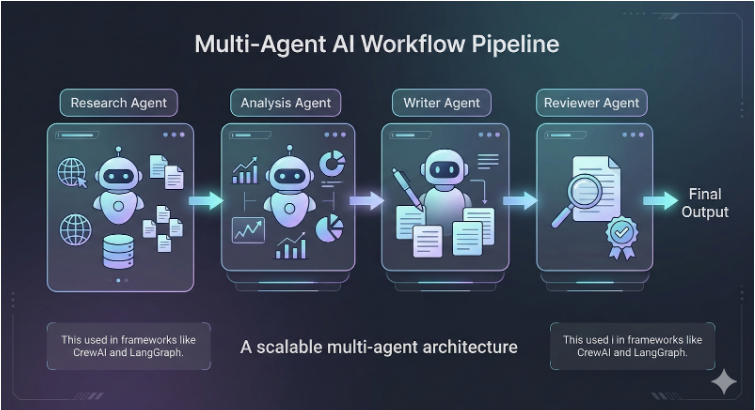
As an illustration, a research workflow can consist of a research agent, which collects data, an analysis agent, which processes and interprets data, a writer agent, which creates structured information and a reviewer agent, which checks accuracy. The system can be more efficient and scalable by making sure that duties are spread among specialized agents.
Multi-agent workflow frameworks like CrewAI and LangGraph have been created specifically to construct multi-agent workflows. These models enable developers to specify the roles of agents, allocate tasks and coordinate interactions among agents.
Coordination between a number of agents is especially useful in the context of the enterprise where work is associated with complicated processes, multifaceted data sets, and group activity.
Real-World Use Cases
Some industries are already using agentic AI, and it has shown itself as a way of automation of complicated procedures. AI agents may be used in software development to help in the generation of codes, debugging, testing and deployment. It is even possible to have some experimental systems to navigate code repositories on their own, detect problems, and suggest solutions.
In customer service, AI agents will be able to process customer support tickets automatically and analyze user requests and transfer demanding issues to human representatives when required. This plays a very important role in minimising response-time and operational cost.
Another area being investigated by the finance industry is agentic systems of automated market analysis, portfolio optimization, and risk assessment. AI-based agents will be able to track financial information simultaneously, identify trends, and provide investors with insights.
In medicine, agentic AI is applied to speed up the process of research. Agents are able to go through scientific literature, derive pertinent results, and help researchers to isolate potential drug candidates. Another sector where AI agents are taking effect is in the area of cybersecurity. Autonomous agents are able to observe activity in the network, identify anomalies and react on a real-time basis to possible threats.
Market Acceptances and Industry Adoptions
AI systems based on agents are being heavily invested in by the technology companies. Large providers of AI are incorporating agent functionalities into their systems to enable enterprise automation.
The tool-calling feature has been introduced in OpenAI, which enables models to communicate with APIs and other applications. Google is working on enhanced agent capabilities in its Gemini. Microsoft is also integrating AI agents in its productivity applications with Copilot integrations, which allow automated workflows in enterprise software environments.
Salesforce has also established AI service agents that are aimed at automating the customer relationship management functions. These advancements suggest that agentic AI is soon becoming a fundamental part of the contemporary digital infrastructure.
According to industry analysts, autonomous agents would become one of the greatest sources of productivity in the coming decade and will change the way organisations process data, make decisions and operational processes.
Research and Academic Developments.
Some powerful research articles have been applied in developing agentic AI. The most prominent of them is ReAct: Synergizing Reasoning and Acting in Language Models that proposed a model that enables language models to integrate reasoning with the use of tools.
In another notable paper, Toolformer, it was shown that language models can be trained in a self-supervised manner to use external tools. The article Generative Agents: Interactive Simulacra of Human Behavior discussed the question of the simulation of realistic human-like interaction by autonomous agents in a digital space.
In the meantime, the autonomous agent Voyager, which is oriented to the Minecraft environment, showed that open-ended learning and exploration could be possible. Such studies are ongoing to expand the limits of autonomous AI systems, allowing the agents to work within more complicated settings.
Future Scope of Agentic AI
The prospects of agentic AI are much more than those presently in use. With better models and improved agent systems, we might soon have entirely autonomous digital workers who are capable of working at complex professional tasks with minimum oversight.
The creation of AI operating systems is one of the possible developments that can be used to control networks of specialized agents. Users may also give goals to an AI centralized system, which coordinates various agents to achieve the goal instead of communicating with individual apps.
One more potential way to go is towards self-improving agents. Such systems would be able to analyze their performance, detect inefficiencies and streamline their processes in the long run. Further progress in the area of reinforcement learning and self-reflection methods can allow agents to never stop improving themselves.
There might also be the emergence of decentralized networks of AI agents where autonomous systems will interact on distributed platforms. Potential changes in industries such as logistics and supply chain management, to scientific research might be achieved through such systems.
Hardships and Ethical Concerns.
Along with the potential of being transformative, agentic AI also brings about major dilemmas. Developing autonomous systems in contact with external tools may cause security threats unless strictly regulated. The safety of agents and their correspondence with human goals is a significant research problem.
Another issue is reliability. Even though language models have developed quite considerably, they are still able to produce false data or defective reasoning processes. These errors may spread across whole workflows when agents are given permission to take actions independently.
There are also constraints on the costs and computational resources. Simultaneously operating several agents may demand a significant amount of computing resources, especially in the case of large language models. The solution to these challenges will involve the development of AI safety, surveillance systems, and effective evaluation systems.
Conclusion
The agentic AI is a paradigm shift in the development of artificial intelligence. With large language models in combination with planning mechanisms, memory systems, and integrations with tools, developers are now able to make systems that do not merely generate and thus do more complex and goal-oriented tasks.
Industrial applications of autonomous AI agents can transform the industry, automatize the work processes, and enhance the efficiency of people. With the continued development of such frameworks such as LangGraph, CrewAI, and AutoGPT, the idea of AI as a collaborative digital workforce is becoming all the more concrete.
Despite serious technical and ethical issues, the pace of development of agent-based AI systems indicates that autonomous agents will become the key element of the new generation of intelligent technologies.
Popular Posts
- Build and Evaluate a RAG Pipeline with RAGAS, LangChain, FAISS, and Groq (Step-by-Step Guide)
- Loop Engineering Explained: From Prompt Engineering to Self-Prompting AI Agents
- Build Your First MCP Server with FastMCP: A Complete Python Tutorial
- MCP vs Function Calling: Key Differences Explained (2026)
- What Is Model Context Protocol (MCP) – A Complete Guide for AI Developers